Pearson+ LogoPearson+ Logo
Ch.14 Carboxylic Acids, Esters, Amines, and Amides
Timberlake - Chemistry: An Introduction to General, Organic, and Biological Chemistry 14th Edition
Timberlake14thChemistry: An Introduction to General, Organic, and Biological ChemistryISBN: 9781292472249Not the one you use?Change textbook
Chapter 14, Problem 66c

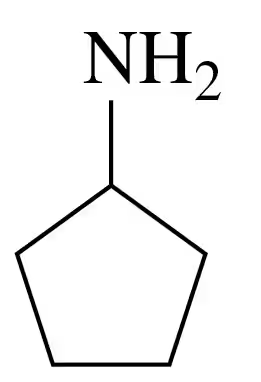
Write the common name and classify each of the following compounds as primary (1°), secondary (2°), or tertiary (3°):
b. Chemical structure of a pentagon with an amine group (NH2) attached, indicating a primary amine.

Verified step by step guidance
1
Step 1: Understand the problem. The task is to determine the common name of the compound and classify it as primary (1°), secondary (2°), or tertiary (3°). Since the compound structure is not provided in the text, we assume it is represented by an image. To proceed, you would need to analyze the structure of the compound in the image.
Step 2: Identify the functional group. Look at the structure of the compound in the image and determine the functional group present (e.g., alcohol, amine, etc.). This will help in naming and classifying the compound.
Step 3: Determine the degree of substitution. For classification: - A primary (1°) compound has the functional group attached to a carbon bonded to only one other carbon. - A secondary (2°) compound has the functional group attached to a carbon bonded to two other carbons. - A tertiary (3°) compound has the functional group attached to a carbon bonded to three other carbons.
Step 4: Assign the common name. Use the structure of the compound to determine its common name. For example, if it is an alcohol, the common name is based on the alkyl group attached to the hydroxyl group (e.g., isopropyl alcohol for a secondary alcohol).
Step 5: Combine the classification and the common name. Once you have determined the degree of substitution and the common name, present both as the final answer (e.g., 'isopropyl alcohol, secondary (2°)').

Verified video answer for a similar problem:

This video solution was recommended by our tutors as helpful for the problem above.
Video duration:
56s
Was this helpful?

Key Concepts

Here are the essential concepts you must grasp in order to answer the question correctly.

Classification of Alcohols

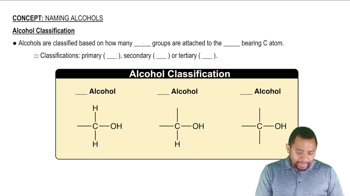
Alcohols are classified based on the number of carbon atoms attached to the carbon bearing the hydroxyl (-OH) group. A primary (1°) alcohol has one carbon atom attached to the carbon with the -OH group, a secondary (2°) alcohol has two, and a tertiary (3°) alcohol has three. This classification is crucial for understanding the reactivity and properties of alcohols.
Recommended video:
Guided course
1:10
Alcohol Classification Concept 2

Functional Groups

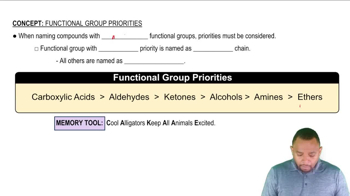
Functional groups are specific groups of atoms within molecules that are responsible for the characteristic chemical reactions of those molecules. In the case of alcohols, the hydroxyl (-OH) group is the functional group that defines their chemical behavior. Recognizing functional groups is essential for predicting the reactivity and classification of organic compounds.
Recommended video:
Guided course
1:11
Functional Group Priorities Concept 1

Nomenclature of Organic Compounds

Nomenclature refers to the systematic naming of chemical compounds. In organic chemistry, the IUPAC (International Union of Pure and Applied Chemistry) rules provide a standardized method for naming compounds based on their structure. Understanding nomenclature is vital for accurately identifying and classifying compounds, especially when determining their common names and classifications.
Recommended video:
Guided course
2:26
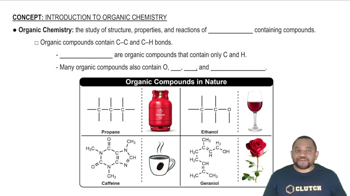
Introduction to Organic Chemistry Concept 1