Pearson+ LogoPearson+ Logo
Ch.14 Carboxylic Acids, Esters, Amines, and Amides
Timberlake - Chemistry: An Introduction to General, Organic, and Biological Chemistry 14th Edition
Timberlake14thChemistry: An Introduction to General, Organic, and Biological ChemistryISBN: 9781292472249Not the one you use?Change textbook
Chapter 14, Problem 79a

Propyl acetate is the ester that gives the odor and smell of pears.
<IMAGE>
a. Draw the condensed structural formula for propyl acetate.

Verified step by step guidance
1
Understand the structure of an ester: Esters are organic compounds with the general formula RCOOR', where R and R' are alkyl or aryl groups. The functional group of an ester is -COO-.
Identify the components of propyl acetate: The name 'propyl acetate' indicates that it is an ester formed from propanol (propyl group) and acetic acid (acetate group). The propyl group (C3H7) is attached to the oxygen atom of the ester functional group, while the acetate group (CH3CO-) forms the other part of the molecule.
Write the condensed structural formula for the acetate group: The acetate group is derived from acetic acid (CH3COOH) by removing the hydrogen atom from the hydroxyl group (-OH). Its condensed structural formula is CH3CO-.
Write the condensed structural formula for the propyl group: The propyl group is a three-carbon alkyl group with the formula C3H7. It can be written as CH3CH2CH2- when attached to the oxygen atom of the ester functional group.
Combine the two groups to form the condensed structural formula of propyl acetate: Attach the propyl group (CH3CH2CH2-) to the oxygen atom of the acetate group (CH3CO-). The resulting condensed structural formula is CH3COOCH2CH2CH3.

Verified video answer for a similar problem:

This video solution was recommended by our tutors as helpful for the problem above.
Video duration:
2m
Was this helpful?

Key Concepts

Here are the essential concepts you must grasp in order to answer the question correctly.

Ester Functional Group

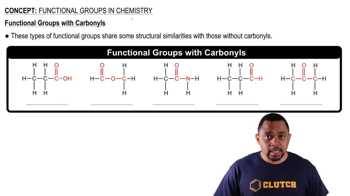
An ester is a chemical compound formed from the reaction between an alcohol and a carboxylic acid, characterized by the functional group -COO-. Esters are known for their distinctive odors and are commonly found in natural and synthetic flavors and fragrances. Understanding the structure of esters is crucial for drawing their condensed structural formulas.
Recommended video:
Guided course
1:32
Functional Groups with Carbonyls Concept 3

Condensed Structural Formula

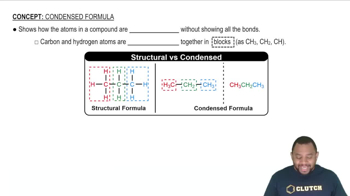
A condensed structural formula is a way of representing a chemical compound that shows the arrangement of atoms in a molecule without depicting all the bonds explicitly. It typically groups atoms together to indicate how they are connected, making it easier to visualize the molecular structure. For propyl acetate, the condensed formula will reflect its ester nature and the specific arrangement of carbon, hydrogen, and oxygen atoms.
Recommended video:
Guided course
1:53
Condensed Formula Concept 1

Chemical Nomenclature

Chemical nomenclature is the systematic naming of chemical compounds based on their structure and functional groups. For esters, the name is derived from the alcohol and the acid used in its formation. In the case of propyl acetate, the name indicates that it is derived from propanol (the alcohol) and acetic acid (the acid), which is essential for understanding its properties and reactivity.
Recommended video:
Guided course
00:58
Chemical Reaction: Chemical Change Concept 1