Pearson+ LogoPearson+ Logo
Ch.14 Carboxylic Acids, Esters, Amines, and Amides
Timberlake - Chemistry: An Introduction to General, Organic, and Biological Chemistry 14th Edition
Timberlake14thChemistry: An Introduction to General, Organic, and Biological ChemistryISBN: 9781292472249Not the one you use?Change textbook
Chapter 14, Problem 79e

Propyl acetate is the ester that gives the odor and smell of pears.
<IMAGE>
e. How many milliliters of a 0.208 M NaOH solution is needed to completely hydrolyze (saponify) 1.58 g of propyl acetate?

Verified step by step guidance
1
Step 1: Write the balanced chemical equation for the hydrolysis (saponification) of propyl acetate. The reaction involves propyl acetate (C5H10O2) reacting with NaOH to produce propanol (C3H8O) and sodium acetate (C2H3O2Na).
Step 2: Calculate the molar mass of propyl acetate (C5H10O2). Add the atomic masses of all the atoms in the molecular formula: (5 × C) + (10 × H) + (2 × O).
Step 3: Convert the given mass of propyl acetate (1.58 g) into moles using the formula: \( \text{moles} = \frac{\text{mass}}{\text{molar mass}} \).
Step 4: Use the stoichiometry of the reaction. From the balanced equation, note that 1 mole of propyl acetate reacts with 1 mole of NaOH. Therefore, the moles of NaOH required will be equal to the moles of propyl acetate calculated in Step 3.
Step 5: Calculate the volume of the 0.208 M NaOH solution needed using the formula: \( \text{Volume (L)} = \frac{\text{moles of NaOH}}{\text{molarity}} \). Convert the volume from liters to milliliters by multiplying by 1000.

Verified video answer for a similar problem:

This video solution was recommended by our tutors as helpful for the problem above.
Video duration:
5m
Was this helpful?

Key Concepts

Here are the essential concepts you must grasp in order to answer the question correctly.

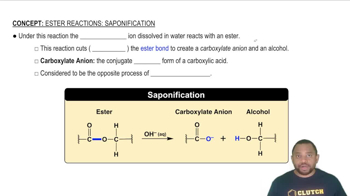
Hydrolysis and Saponification

Hydrolysis is a chemical reaction involving the breaking of a bond in a molecule using water. In the context of esters like propyl acetate, saponification refers to the hydrolysis of the ester in the presence of a base, typically sodium hydroxide (NaOH), resulting in the formation of an alcohol and a carboxylate salt. This process is essential for understanding how esters can be converted into their corresponding acids and alcohols.
Recommended video:
Guided course
1:25
Ester Reactions: Saponification Concept 1

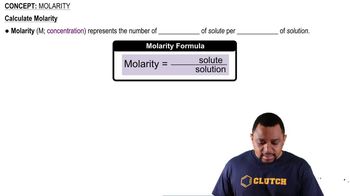
Molarity and Solution Concentration

Molarity (M) is a measure of concentration defined as the number of moles of solute per liter of solution. In this question, a 0.208 M NaOH solution indicates that there are 0.208 moles of NaOH in every liter of the solution. Understanding molarity is crucial for calculating the volume of NaOH needed to react with a given mass of propyl acetate during the hydrolysis process.
Recommended video:

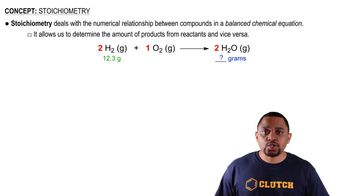
Stoichiometry

Stoichiometry is the area of chemistry that deals with the relationships between the quantities of reactants and products in a chemical reaction. It allows us to calculate how much of one substance is needed to react with a given amount of another. In this case, stoichiometry will help determine the amount of NaOH required to completely hydrolyze the specified mass of propyl acetate, based on the balanced chemical equation for the reaction.
Recommended video:
Guided course
01:16
Stoichiometry