Pearson+ LogoPearson+ Logo
Ch.15 Lipids
Timberlake - Chemistry: An Introduction to General, Organic, and Biological Chemistry 13th Edition
Timberlake13th EditionChemistry: An Introduction to General, Organic, and Biological ChemistryISBN: 9780134421353Not the one you use?Change textbook
Chapter 15, Problem 29b

Identify each of the following processes as hydrogenation, hydrolysis, or saponification and give the products:
b. the reaction of glyceryl trilinoleate from safflower oil with water and HCl

Verified step by step guidance
1
Step 1: Recognize the type of reaction described. The reaction involves glyceryl trilinoleate (a triglyceride) reacting with water and HCl. This is a hydrolysis reaction, as it involves breaking chemical bonds using water.
Step 2: Understand the structure of glyceryl trilinoleate. It is a triglyceride composed of a glycerol backbone esterified with three linoleic acid molecules (a type of fatty acid).
Step 3: In a hydrolysis reaction, the ester bonds in the triglyceride are broken. This occurs in the presence of water and an acid catalyst (HCl in this case). Each ester bond is cleaved, resulting in the formation of glycerol and free fatty acids.
Step 4: Write the chemical equation for the reaction. The general reaction is: ext{C}_3 ext{H}_5( ext{OCOC}_{17} ext{H}_{31})_3 + 3 ext{H}_2 ext{O} ightarrow ext{C}_3 ext{H}_8 ext{O}_3 + 3 ext{C}_{18} ext{H}_{32} ext{O}_2 , where glycerol (C₃H₈O₃) and linoleic acid (C₁₈H₃₂O₂) are the products.
Step 5: Conclude that the products of this hydrolysis reaction are glycerol and three molecules of linoleic acid. This process is typical of triglyceride hydrolysis in the presence of an acid catalyst.

Verified video answer for a similar problem:

This video solution was recommended by our tutors as helpful for the problem above.
Video duration:
2m
Was this helpful?

Key Concepts

Here are the essential concepts you must grasp in order to answer the question correctly.

Hydrolysis

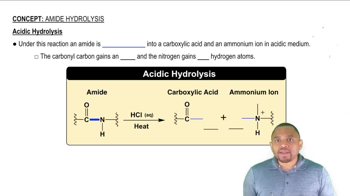
Hydrolysis is a chemical process in which water is used to break down a compound. In the context of fats and oils, hydrolysis involves the reaction of triglycerides with water, often in the presence of an acid or base, resulting in the formation of glycerol and fatty acids. This process is essential in understanding how lipids can be broken down in biological systems.
Recommended video:
Guided course
1:12
Acidic Hydrolysis Concept 1

Glyceryl Trilinoleate

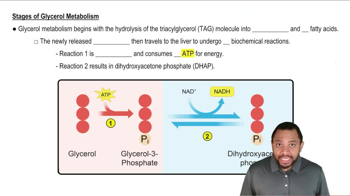
Glyceryl trilinoleate, also known as trilinolein, is a triglyceride composed of glycerol and three linoleic acid molecules. It is commonly found in safflower oil and is a type of unsaturated fat. Understanding its structure is crucial for predicting the products of its hydrolysis, as the fatty acid chains will be released during the reaction.
Recommended video:
Guided course
1:20
Glycerol Metabolism Concept 2

Acid-Catalyzed Hydrolysis

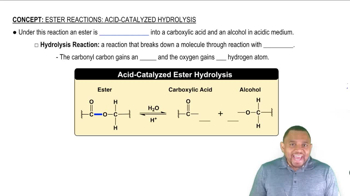
Acid-catalyzed hydrolysis refers to the process where an acid, such as hydrochloric acid (HCl), accelerates the hydrolysis reaction. In this scenario, the acid donates protons, facilitating the breakdown of the triglyceride into glycerol and free fatty acids. This concept is important for understanding how the presence of an acid can influence the rate and outcome of hydrolysis reactions.
Recommended video:
Guided course
1:14
Acid-Catalyzed Ester Hydrolysis Concept 1