Pearson+ LogoPearson+ Logo
Ch.15 Lipids
Timberlake - Chemistry: An Introduction to General, Organic, and Biological Chemistry 13th Edition
Timberlake13th EditionChemistry: An Introduction to General, Organic, and Biological ChemistryISBN: 9780134421353Not the one you use?Change textbook
Chapter 15, Problem 30a

Identify each of the following processes as hydrogenation, hydrolysis, or saponification and give the products:
a. the reaction of corn oil and hydrogen (H2) with a nickel catalyst

Verified step by step guidance
1
Step 1: Recognize the type of reaction described in the problem. The reaction involves corn oil (a triglyceride) and hydrogen (H₂) in the presence of a nickel catalyst. This setup is characteristic of a hydrogenation reaction.
Step 2: Understand the process of hydrogenation. In hydrogenation, hydrogen (H₂) is added to the double bonds of unsaturated fatty acids in the triglyceride, converting them into single bonds. This process reduces the degree of unsaturation in the fatty acids.
Step 3: Identify the structural change in the triglyceride. The double bonds in the unsaturated fatty acids of corn oil are replaced with single bonds, resulting in the formation of saturated fatty acids.
Step 4: Predict the product of the reaction. The product of the hydrogenation of corn oil is a triglyceride with more saturated fatty acids, which is typically a solid or semi-solid fat at room temperature.
Step 5: Summarize the reaction. The process is hydrogenation, and the product is a more saturated form of the triglyceride (corn oil), often referred to as partially or fully hydrogenated oil.

Verified video answer for a similar problem:

This video solution was recommended by our tutors as helpful for the problem above.
Video duration:
2m
Was this helpful?

Key Concepts

Here are the essential concepts you must grasp in order to answer the question correctly.

Hydrogenation

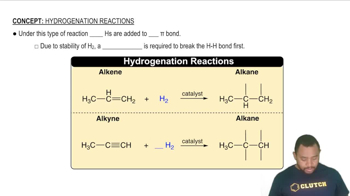
Hydrogenation is a chemical reaction that involves the addition of hydrogen (H₂) to unsaturated organic compounds, typically alkenes or alkynes, to convert them into saturated compounds. This process is commonly used in the food industry to convert liquid vegetable oils into solid or semi-solid fats, improving shelf life and texture. In the context of the question, the reaction of corn oil with hydrogen in the presence of a nickel catalyst exemplifies hydrogenation, resulting in the formation of saturated fats.
Recommended video:
Guided course
1:22
Hydrogenation Reactions Concept 1

Corn Oil

Corn oil is a type of vegetable oil extracted from the germ of corn (maize). It is primarily composed of polyunsaturated fatty acids, making it liquid at room temperature. When corn oil undergoes hydrogenation, its unsaturated fatty acids are converted into saturated fatty acids, which alters its physical properties, such as melting point and stability. Understanding the composition of corn oil is essential for predicting the outcomes of its hydrogenation.
Recommended video:
Guided course
04:22
Rutherford Gold Foil Oil Experiment

Nickel Catalyst

A nickel catalyst is a substance that accelerates the rate of a chemical reaction without being consumed in the process. In hydrogenation reactions, nickel is commonly used due to its effectiveness in facilitating the addition of hydrogen to unsaturated bonds. The presence of a nickel catalyst in the reaction between corn oil and hydrogen is crucial, as it lowers the activation energy required for the reaction, allowing it to proceed more efficiently and at lower temperatures.
Recommended video:
Guided course
1:57
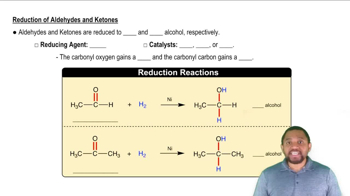
Reduction of Aldehydes and Ketones Concept 2