Pearson+ LogoPearson+ Logo
Ch.15 Lipids
Timberlake - Chemistry: An Introduction to General, Organic, and Biological Chemistry 13th Edition
Timberlake13th EditionChemistry: An Introduction to General, Organic, and Biological ChemistryISBN: 9780134421353Not the one you use?Change textbook
Chapter 15, Problem 30b

Identify each of the following processes as hydrogenation, hydrolysis, or saponification and give the products:
b. the reaction of glyceryl tristearate with water in the presence of lipase enzyme

Verified step by step guidance
1
Step 1: Recognize the type of reaction described. The reaction involves glyceryl tristearate (a triglyceride) reacting with water in the presence of a lipase enzyme. This is a hydrolysis reaction, as water is used to break chemical bonds.
Step 2: Understand the role of the lipase enzyme. Lipase acts as a catalyst to speed up the hydrolysis of the triglyceride into its components.
Step 3: Write the general reaction for the hydrolysis of a triglyceride. A triglyceride reacts with water to produce glycerol and three fatty acid molecules. The reaction can be represented as: Triglyceride + H2OGlycerol + 3Fatty Acids
Step 4: Identify the specific products for glyceryl tristearate. Glyceryl tristearate is a triglyceride composed of glycerol and three stearic acid molecules. When hydrolyzed, it produces one molecule of glycerol and three molecules of stearic acid.
Step 5: Summarize the reaction. The hydrolysis of glyceryl tristearate in the presence of a lipase enzyme produces glycerol and three stearic acid molecules as the products.

Verified video answer for a similar problem:

This video solution was recommended by our tutors as helpful for the problem above.
Video duration:
2m
Was this helpful?

Key Concepts

Here are the essential concepts you must grasp in order to answer the question correctly.

Hydrolysis

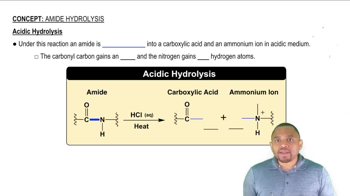
Hydrolysis is a chemical process in which water is used to break down a compound. In the context of lipids, hydrolysis typically involves the cleavage of ester bonds in triglycerides, resulting in the formation of glycerol and fatty acids. This reaction is essential in biological systems for the digestion of fats.
Recommended video:
Guided course
1:12
Acidic Hydrolysis Concept 1

Lipase Enzyme

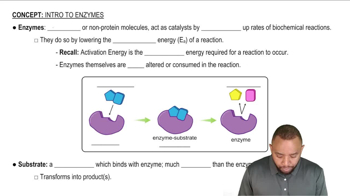
Lipase is an enzyme that catalyzes the hydrolysis of fats (lipids) into glycerol and free fatty acids. It plays a crucial role in the digestive system, facilitating the breakdown of dietary fats into absorbable units. The presence of lipase significantly increases the rate of hydrolysis compared to the reaction occurring without an enzyme.
Recommended video:
Guided course
2:14
Intro to Enzymes Concept 1

Glyceryl Tristearate

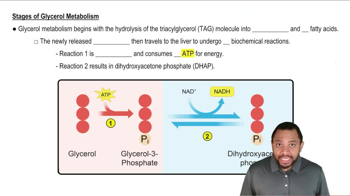
Glyceryl tristearate, also known as triglyceride or stearin, is a type of fat composed of glycerol and three stearic acid molecules. It is a common component of dietary fats and is found in many animal and plant oils. Understanding its structure is important for recognizing how it undergoes hydrolysis in the presence of water and enzymes.
Recommended video:
Guided course
1:20
Glycerol Metabolism Concept 2