Pearson+ LogoPearson+ Logo
Ch. 15 - Recombinant DNA Technology and Its Applications
Sanders - Genetic Analysis: An Integrated Approach 3rd Edition
Sanders3rd EditionGenetic Analysis: An Integrated ApproachISBN: 9780135564172Not the one you use?Change textbook
Chapter 15, Problem E.8

Figure E.1 illustrates the results of an electrophoretic analysis of 13 CODIS STR markers on a DNA sample and identifies the alleles for each gene. Table E.2 lists the frequencies for alleles of three of the STRs shown in the figure. Use this information to calculate the frequency of the genotype for STR genes FGA, vWA, and D3S1358 given in Figure E.1.

Verified step by step guidance
1
Identify the alleles for each STR gene (FGA, vWA, and D3S1358) from the electrophoretic analysis results shown in Figure E.1. Note whether the genotype is homozygous (same alleles) or heterozygous (different alleles) for each STR.
Locate the allele frequencies for each identified allele of the three STR genes in Table E.2. These frequencies represent the proportion of each allele in the population.
For each STR gene, calculate the genotype frequency using the Hardy-Weinberg principle: if the genotype is homozygous (allele A and allele A), use the formula p^2, where p is the frequency of allele A; if heterozygous (allele A and allele B), use the formula 2

q, where p and q are the frequencies of alleles A and B respectively.

Calculate the genotype frequency for each of the three STR genes separately by substituting the allele frequencies into the appropriate formula from step 3.
Multiply the genotype frequencies of the three STR genes together to find the combined genotype frequency for the individual, assuming the loci are independent and in Hardy-Weinberg equilibrium.

Verified video answer for a similar problem:

This video solution was recommended by our tutors as helpful for the problem above.
Video duration:
2m
Was this helpful?

Key Concepts

Here are the essential concepts you must grasp in order to answer the question correctly.

Short Tandem Repeats (STRs)

STRs are short sequences of DNA, typically 2-6 base pairs long, repeated multiple times in a row at specific loci. They are highly polymorphic, making them useful for genetic identification and forensic analysis. Each individual has two alleles per STR locus, inherited from each parent.
Recommended video:

Allele Frequency and Genotype Frequency

Allele frequency is the proportion of a specific allele variant in a population. Genotype frequency refers to how often a particular combination of alleles (genotype) occurs. For STRs, genotype frequency can be calculated using allele frequencies, assuming Hardy-Weinberg equilibrium.
Recommended video:
Guided course
03:03
New Alleles and Migration

Hardy-Weinberg Equilibrium

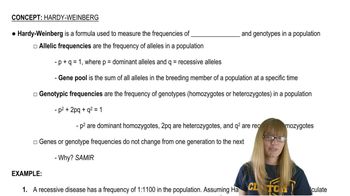
This principle states that allele and genotype frequencies in a large, randomly mating population remain constant across generations if no evolutionary forces act. It allows calculation of genotype frequencies from allele frequencies using the formula p² + 2pq + q² = 1, where p and q are allele frequencies.
Recommended video:
Guided course
13:04
Hardy Weinberg
Related Practice
Textbook Question

Using animal models of human diseases can lead to insights into the cellular and genetic bases of the diseases. Duchenne muscular dystrophy (DMD) is the consequence of an X-linked recessive allele.

How would you make a mouse model of DMD?

Textbook Question

Using animal models of human diseases can lead to insights into the cellular and genetic bases of the diseases. Duchenne muscular dystrophy (DMD) is the consequence of an X-linked recessive allele.

How would you make a Drosophila model of DMD?

Textbook Question
Compare methods for constructing homologous recombinant transgenic mice and yeast.
2
views
Textbook Question
Chimeric gene-fusion products can be used for medical or industrial purposes. One idea is to produce biological therapeutics for human medical use in animals from which the products can be easily harvested—in the milk of sheep or cattle, for example. Outline how you would produce human insulin in the milk of sheep.
Textbook Question

Additional STR allele frequency information can be added to improve the analysis in Problem 8. The frequency of D8S1179₁₂ = 0.12. The frequency of D16S539₁₈ = 0.08 and of D16S539₂₀ = 0.21. Lastly, D18S51₁₉ = 0.13 and D18S51₂₀ = 0.10. Combine the allele frequency information for these three STR genes with the information used in Problem 8 to calculate the frequency of the genotype for six of the STR genes.

Textbook Question
Why are diseases of the blood simpler targets for treatment by gene therapy than are many other genetic diseases?
4
views