Back
Back
Problem 25
Factor ƒ(x) into linear factors given that k is a zero.
Problem 25
Use an end behavior diagram, as shown below, to describe the end behavior of the graph of each polynomial function. ƒ(x)=9x6-3x4+x2-2
Problem 25
Solve each polynomial inequality. Give the solution set in interval notation. See Examples 2 and 3. (2x - 1)(5x - 9)(x - 4) < 0
Problem 25
Write each formula as an English phrase using the word varies or proportional. V = 1/3 πr2h, where V is the volume of a cone of radius r and height h
Problem 25
Find a polynomial function ƒ(x) of least degree with real coefficients having zeros as given. √3, -√3, 2, 3
Problem 26
Graph each quadratic function. Give the (a) vertex, (b) axis, (c) domain, and (d) range. ƒ(x) = (x - 5)2 - 4
Problem 26
Use an end behavior diagram, as shown below, to describe the end behavior of the graph of each polynomial function. ƒ(x)=10x6-x5+2x-2
Problem 26
Find a polynomial function ƒ(x) of least degree with real coefficients having zeros as given. -2+√5, -2-√5, -2, 1
Problem 26
Use synthetic division to divide ƒ(x) by x-k for the given value of k. Then express ƒ(x) in the form ƒ(x) = (x-k) q(x) + r. ƒ(x) = 2x3 + 3x2 - 16x+10; k = -4
Problem 27
Graph each quadratic function. Give the (a) vertex, (b) axis, (c) domain, and (d) range. ƒ(x) = -(1/2)(x + 1)2 - 3
Problem 27
Circumference of a Circle The circumference of a circle varies directly as the radius. A circle with radius 7 in. has circumference 43.96 in. Find the circumference of the circle if the radius changes to 11 in.
Problem 27
Solve each polynomial inequality. Give the solution set in interval notation. (x - 4)(2x + 3)(3x - 1) ≥ 0
Problem 27
Use an end behavior diagram, as shown below, to describe the end behavior of the graph of each polynomial function. ƒ(x)=3+2x-4x2-5x10
Problem 28
Use an end behavior diagram, as shown below, to describe the end behavior of the graph of each polynomial function. ƒ(x)=7+2x-5x2-10x4
Problem 28
Graph each quadratic function. Give the (a) vertex, (b) axis, (c) domain, and (d) range. ƒ(x) = -3 (x - 2)2 +1
Problem 29
Solve each polynomial inequality. Give the solution set in interval notation. (x - 3)(x - 4)(x - 5)2 ≤ 0
Problem 29
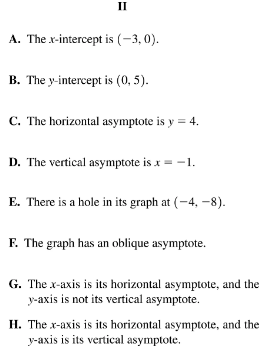
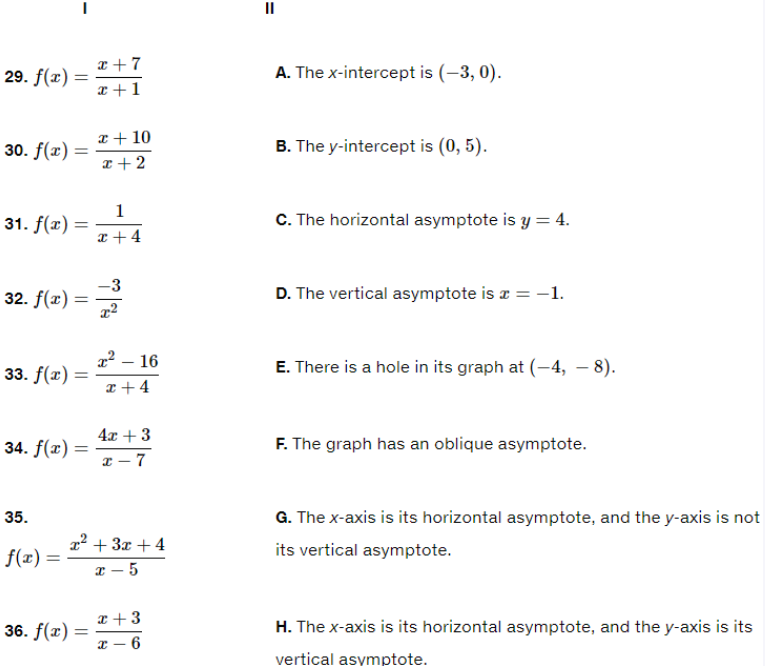
Match the rational function in Column I with the appropriate description in Column II. Choices in Column II can be used only once.
Problem 29
Resistance of a Wire The resistance in ohms of a platinum wire temperature sensor varies directly as the temperature in kelvins (K). If the resistance is 646 ohms at a temperature of 190 K, find the resistance at a temperature of 250 K.
Problem 30
Graph each quadratic function. Give the (a) vertex, (b) axis, (c) domain, and (d) range. ƒ(x) = x2 + 6x + 5
Problem 30
Find all rational zeros of each function.
Problem 31
Distance to the Horizon The distance that a person can see to the horizon on a clear day from a point above the surface of Earth varies directly as the square root of the height at that point. If a person 144 m above the surface of Earth can see 18 km to the horizon, how far can a person see to the horizon from a point 64 m above the surface?
Problem 31
Match the rational function in Column I with the appropriate description in Column II. Choices in Column II can be used only once. ƒ(x)=1/(x+4)
Problem 31
Factor into linear factors given that k is a zero. (multiplicity )
Problem 31
Graph each polynomial function. Factor first if the polynomial is not in factored form. ƒ(x)=-2x(x-3)(x+2)
Problem 31
Use synthetic division to divide ƒ(x) by x-k for the given value of k. Then express ƒ(x) in the form ƒ(x) = (x-k) q(x) + r. ƒ(x) = 3x4 + 4x3 - 10x2 + 15; k = -1
Problem 31
Solve each polynomial inequality. Give the solution set in interval notation. -(x - 3)(x - 4)2 (x - 5) > 0
Problem 31a
Show that each polynomial function has a real zero as described in parts (a) and (b). In Exercises 31 and 32, also work part (c). ƒ(x)=3x^3-8x^2+x+2 between -1 and 0
Problem 31b
Show that each polynomial function has a real zero as described in parts (a) and (b). In Exercises 31 and 32, also work part (c). ƒ(x)=3x^3-8x^2+x+2 between 2 and 3
Problem 31c
Show that each polynomial function has a real zero as described in parts (a) and (b). In Exercises 31 and 32, also work part (c). ƒ(x)=3x^3-8x^2+x+2 Find the zero in part (b) to three decimal places.
Problem 32
Graph each polynomial function. Factor first if the polynomial is not in factored form. ƒ(x)=-x(x+1)(x-1)