Back
Back
Problem 21
Find the midpoint of each line segment with the given endpoints. (-2, -8) and (−6, −2)
Problem 21
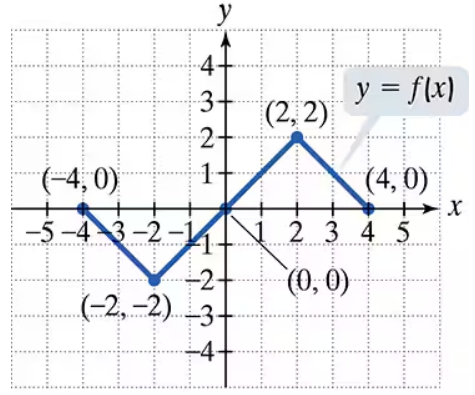
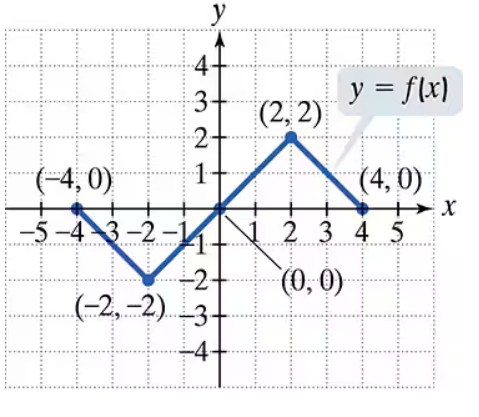
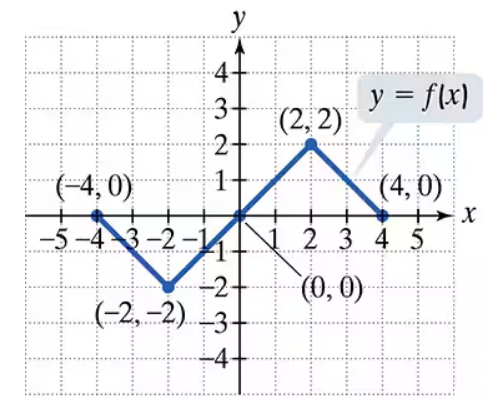
Use the graph of y = f(x) to graph each function g.
g(x) = f(x-1)+2
Problem 21a
Determine whether each equation defines y as a function of x. x+y³ = 8
Problem 22
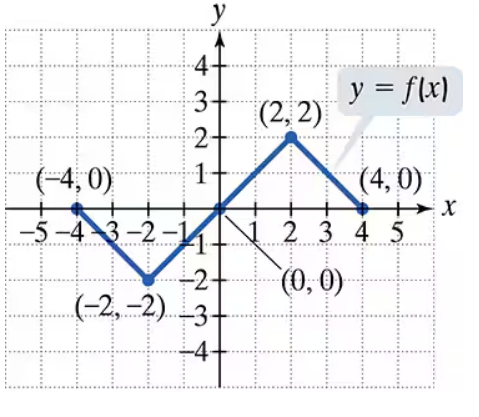
Use the graph of y = f(x) to graph each function g. g(x) = f(x + 1) − 2
Problem 23
The functions in Exercises 11-28 are all one-to-one. For each function, a. Find an equation for f-1(x), the inverse function. b. Verify that your equation is correct by showing that f(ƒ-1 (x)) = = x and ƒ-1 (f(x)) = x. f(x) = √x
Problem 23
Determine whether the graph of each equation is symmetric with respect to the y-axis, the x-axis, the origin, more than one of those, or none of these. x^2 + y^2 =17
Problem 23
Find the domain of each function. f(x) = √(24 - 2x)
Problem 23
Find the midpoint of each line segment with the given endpoints. (-3, -4) and (6, −8)
Problem 23a
Write an equation in slope-intercept form of a linear function f whose graph satisfies the given conditions. The graph of ƒ is perpendicular to the line whose equation is 3x - 2y - 4 = 0 and has the same y-intercept as this line.
Problem 24
Use the given conditions to write an equation for each line in point-slope form and slope-intercept form. Slope = - 3/5, passing through (10, −4)
Problem 24
In Exercises 11–26, determine whether each equation defines y as a function of x. xy - 5y =1
Problem 24
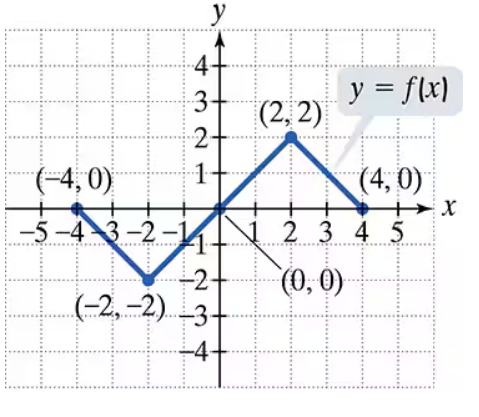
Use the graph of y = f(x) to graph each function g. g(x) = f(-x)
Problem 25
In Exercises 11–26, determine whether each equation defines y as a function of x. |x| − y = 2
Problem 25
The functions in Exercises 11-28 are all one-to-one. For each function, a. Find an equation for f-1(x), the inverse function. b. Verify that your equation is correct by showing that f(ƒ-1 (x)) = = x and ƒ-1 (f(x)) = x. f(x) = (x +4)/(x-2)
Problem 25
Find the midpoint of each line segment with the given endpoints. (-7/2, 3/2) and (-5/2, -11/2)
Problem 25
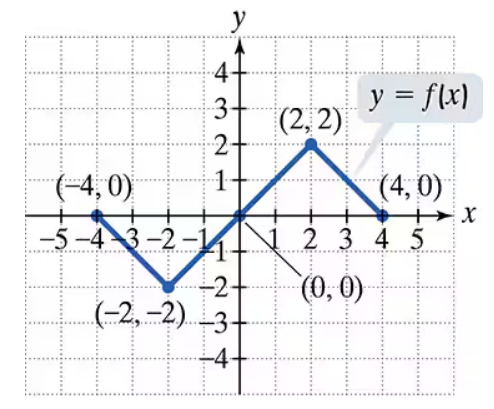
Use the graph of y = f(x) to graph each function g.
g(x) = f(-x)+1
Problem 25a
Find the domain of each function. h(x) = √(x −2)+ √(x +3)
Problem 26
Determine whether each graph is the graph of an even function, an odd function, or a function that is neither even nor odd.

Problem 26
Use the graph of y = f(x) to graph each function g. g(x) = -f(x)+1
Problem 26a
Determine whether each equation defines y as a function of x. |x|- y = 5
Problem 27
Find the domain of each function. g(x) = √(x −2) /(x-5)
Problem 27
The functions in Exercises 11-28 are all one-to-one. For each function, a. Find an equation for f-1(x), the inverse function. b. Verify that your equation is correct by showing that f(ƒ-1 (x)) = = x and ƒ-1 (f(x)) = x. f(x) = (2x +1)/(x-3)
Problem 27
Find the midpoint of each line segment with the given endpoints. (8, 3√5) and (−6, 7√5)
Problem 27a
In Exercises 27–38, evaluate each function at the given values of the independent variable and simplify.f(x)=4x+5 a. f(6)
Problem 27b
In Exercises 27–38, evaluate each function at the given values of the independent variable and simplify.f(x)=4x+5 b. f(x + 1)
Problem 27c
In Exercises 27–38, evaluate each function at the given values of the independent variable and simplify.f(x)=4x+5 c. f(-x)
Problem 28
Use the graph of y = f(x) to graph each function g.
g(x) = ½ f(x)
Problem 28
Find the midpoint of each line segment with the given endpoints. (7√3, −6) and (3√3, −2)
Problem 28
Use the given conditions to write an equation for each line in point-slope form and slope-intercept form. Passing through (-2, 0) and (0, 2)
Problem 29
Find the domain of each function. f(x) = (2x+7)/(x3 - 5x2 - 4x+20)