Pearson+ LogoPearson+ Logo
Ch.16 Amino Acids, Proteins, and Enzymes
Timberlake - Chemistry: An Introduction to General, Organic, and Biological Chemistry 14th Edition
Timberlake14thChemistry: An Introduction to General, Organic, and Biological ChemistryISBN: 9781292472249Not the one you use?Change textbook
Chapter 16, Problem 35b

Match the terms (1) enzyme–substrate complex, (2) enzyme, and (3) substrate with each of the following:
b. the combination of an enzyme with the substrate

Verified step by step guidance
1
Understand the key terms: An enzyme is a biological catalyst that speeds up chemical reactions, a substrate is the molecule upon which the enzyme acts, and the enzyme–substrate complex is the intermediate formed when the enzyme binds to the substrate.
Recognize that the question is asking for the term that describes the combination of an enzyme with the substrate.
Recall that the enzyme–substrate complex specifically refers to the temporary structure formed when the enzyme and substrate are bound together during the reaction process.
Match the term 'enzyme–substrate complex' with the description 'the combination of an enzyme with the substrate.'
Confirm that the other terms (enzyme and substrate) do not describe the combination but rather the individual components involved in the reaction.

Verified video answer for a similar problem:

This video solution was recommended by our tutors as helpful for the problem above.
Video duration:
1m
Was this helpful?

Key Concepts

Here are the essential concepts you must grasp in order to answer the question correctly.

Enzyme

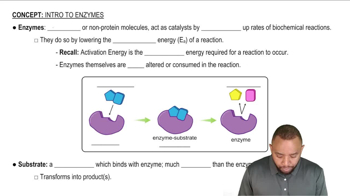
An enzyme is a biological catalyst that accelerates chemical reactions in living organisms. It is typically a protein that lowers the activation energy required for a reaction to occur, thereby increasing the reaction rate. Enzymes are specific to substrates, meaning each enzyme only catalyzes a particular reaction or type of reaction.
Recommended video:
Guided course
2:14
Intro to Enzymes Concept 1

Substrate

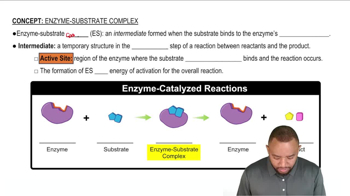
A substrate is a molecule upon which an enzyme acts. It binds to the enzyme's active site, forming an enzyme-substrate complex. The interaction between the enzyme and substrate is crucial for the catalytic process, as it allows the enzyme to convert the substrate into products through a series of chemical transformations.
Recommended video:
Guided course
2:32
Enzyme-Substrate Complex Concept 1

Enzyme-Substrate Complex

The enzyme-substrate complex is the transient molecular structure formed when a substrate binds to the active site of an enzyme. This complex is essential for the catalytic activity of the enzyme, as it stabilizes the transition state and facilitates the conversion of the substrate into products. Understanding this complex is key to grasping how enzymes function in biochemical reactions.
Recommended video:
Guided course
2:32
Enzyme-Substrate Complex Concept 1