Pearson+ LogoPearson+ Logo
Ch.15 Lipids
Timberlake - Chemistry: An Introduction to General, Organic, and Biological Chemistry 14th Edition
Timberlake14thChemistry: An Introduction to General, Organic, and Biological ChemistryISBN: 9781292472249Not the one you use?Change textbook
Chapter 15, Problem 80b

 Identify each of the following as a fatty acid, soap, triacylglycerol, wax, glycerophospholipid, sphingolipid, or steroid:
a. sphingomyelin

Verified step by step guidance
1
Step 1: Understand the classification of lipids. Lipids are a diverse group of compounds that include fatty acids, soaps, triacylglycerols, waxes, glycerophospholipids, sphingolipids, and steroids. Each type has distinct structural features and functions.
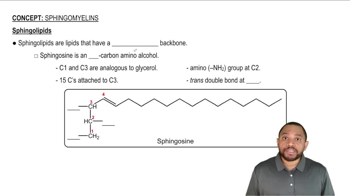
Step 2: Recognize the structure of sphingomyelin. Sphingomyelin is a type of sphingolipid, which is characterized by a sphingosine backbone rather than a glycerol backbone. It also contains a phosphate group and a fatty acid chain.
Step 3: Note the functional groups present in sphingomyelin. It includes a sphingosine backbone, a fatty acid chain attached via an amide bond, and a phosphate group linked to a choline or ethanolamine group.
Step 4: Compare sphingomyelin to other lipid types. Unlike triacylglycerols or glycerophospholipids, sphingomyelin does not have a glycerol backbone. It is distinct from steroids, which are based on a fused ring structure, and from waxes, which are esters of long-chain alcohols and fatty acids.
Step 5: Conclude that sphingomyelin is classified as a sphingolipid due to its sphingosine backbone, fatty acid chain, and phosphate group.

Key Concepts

Here are the essential concepts you must grasp in order to answer the question correctly.

Sphingolipid

Sphingolipids are a class of lipids that contain a backbone of sphingosine, an amino alcohol. They play crucial roles in cellular structure and signaling, particularly in the membranes of cells. Sphingomyelin, a type of sphingolipid, is found in the myelin sheath of nerve cells and is important for insulating nerve fibers.
Recommended video:
Guided course
1:32
Sphingomyelins Concept 1

Lipid Classification

Lipids are categorized into various classes based on their structure and function, including fatty acids, triglycerides, phospholipids, and steroids. Understanding these classifications helps in identifying specific lipids like sphingomyelin, which is a sphingolipid, and differentiating them from other lipid types based on their chemical properties and biological roles.
Recommended video:
Guided course
1:28
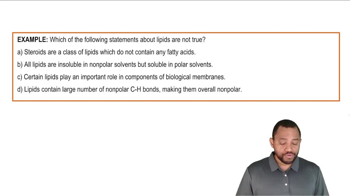
Intro to Lipids Example 1

Biological Significance of Sphingomyelin

Sphingomyelin is significant in maintaining the integrity of cell membranes and is involved in signaling pathways. It contributes to the formation of lipid rafts, which are microdomains in the membrane that facilitate cell signaling and interactions. Its presence in the nervous system highlights its role in neurobiology and myelin sheath formation.
Recommended video:
Guided course
3:11
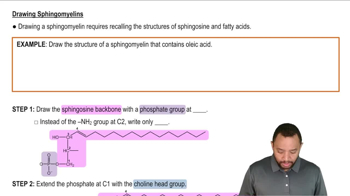
Sphingomyelins Example 2