Pearson+ LogoPearson+ Logo
Ch.15 Lipids
Timberlake - Chemistry: An Introduction to General, Organic, and Biological Chemistry 14th Edition
Timberlake14thChemistry: An Introduction to General, Organic, and Biological ChemistryISBN: 9781292472249Not the one you use?Change textbook
Chapter 15, Problem 79d

 Identify each of the following as a fatty acid, soap, triacylglycerol, wax, glycerophospholipid, sphingolipid, or steroid:
d. glyceryl tripalmitate (tripalmitin)

Verified step by step guidance
1
Step 1: Understand the structure of glyceryl tripalmitate (tripalmitin). It is a triacylglycerol, which consists of a glycerol backbone esterified with three fatty acid chains. In this case, the fatty acid is palmitic acid (a 16-carbon saturated fatty acid).
Step 2: Recall the definition of a triacylglycerol. A triacylglycerol is a lipid formed by the esterification of three fatty acids to a glycerol molecule. These are commonly found in fats and oils and serve as energy storage molecules in the body.
Step 3: Compare the structure of glyceryl tripalmitate to other lipid categories. It does not fit the structure of a fatty acid (a single carboxylic acid chain), soap (a salt of a fatty acid), wax (a long-chain alcohol esterified to a fatty acid), glycerophospholipid (contains a phosphate group), sphingolipid (contains a sphingosine backbone), or steroid (characterized by a four-ring structure).
Step 4: Confirm that glyceryl tripalmitate matches the characteristics of a triacylglycerol. It has a glycerol backbone and three fatty acid chains, which are the defining features of this lipid category.
Step 5: Conclude that glyceryl tripalmitate (tripalmitin) is classified as a triacylglycerol based on its structure and functional characteristics.

Verified video answer for a similar problem:

This video solution was recommended by our tutors as helpful for the problem above.
Video duration:
2m
Was this helpful?

Key Concepts

Here are the essential concepts you must grasp in order to answer the question correctly.

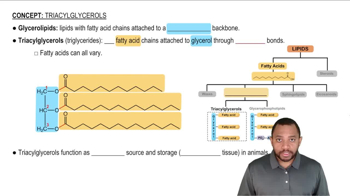
Triacylglycerol

Triacylglycerols, also known as triglycerides, are esters formed from glycerol and three fatty acids. They serve as a major form of energy storage in animals and plants. When the body requires energy, triacylglycerols are broken down into glycerol and fatty acids through hydrolysis.
Recommended video:
Guided course
1:52
Triacylglycerols Concept 1

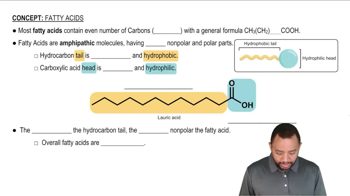
Fatty Acid

Fatty acids are long hydrocarbon chains with a carboxylic acid group at one end. They can be saturated, containing no double bonds, or unsaturated, containing one or more double bonds. Fatty acids are key components of lipids, including triacylglycerols and phospholipids, and play crucial roles in metabolism and cell structure.
Recommended video:
Guided course
2:00
Fatty Acids Concept 1

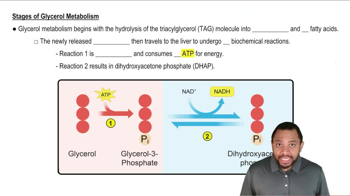
Glycerol

Glycerol is a three-carbon alcohol that serves as the backbone for triacylglycerols and phospholipids. Each of its three hydroxyl groups can form an ester bond with fatty acids, resulting in the formation of lipids. Glycerol is also involved in various metabolic pathways, including glycolysis and gluconeogenesis.
Recommended video:
Guided course
1:20
Glycerol Metabolism Concept 2