Pearson+ LogoPearson+ Logo
Ch.14 Carboxylic Acids, Esters, Amines, and Amides
Timberlake - Chemistry: An Introduction to General, Organic, and Biological Chemistry 14th Edition
Timberlake14thChemistry: An Introduction to General, Organic, and Biological ChemistryISBN: 9781292472249Not the one you use?Change textbook
Chapter 14, Problem 22c

Draw the condensed structural formulas for a and b and line-angle formulas for c and d:
c. propyl benzoate

Verified step by step guidance
1
Step 1: Understand the structure of propyl benzoate. It is an ester formed from benzoic acid (C₆H₅COOH) and propanol (C₃H₇OH). The esterification reaction replaces the hydroxyl group (-OH) of benzoic acid with the propyl group (-C₃H₇).
Step 2: Write the condensed structural formula for propyl benzoate. Start with the benzene ring (C₆H₅) attached to the carbonyl group (C=O), followed by the propyl group (-CH₂CH₂CH₃). The condensed formula is C₆H₅COOCH₂CH₂CH₃.
Step 3: To draw the line-angle formula, represent the benzene ring as a hexagon with alternating double bonds. Attach the carbonyl group (C=O) to one of the carbons in the ring, and then connect the oxygen atom to the propyl chain (-CH₂CH₂CH₃).
Step 4: Ensure that the line-angle formula accurately represents the structure. The benzene ring should have six vertices, the carbonyl group should be double-bonded to one carbon, and the propyl chain should extend from the oxygen atom.
Step 5: Double-check the structure for accuracy, ensuring that all bonds and atoms are correctly represented in both the condensed structural formula and the line-angle formula.

Verified video answer for a similar problem:

This video solution was recommended by our tutors as helpful for the problem above.
Video duration:
2m
Was this helpful?

Key Concepts

Here are the essential concepts you must grasp in order to answer the question correctly.

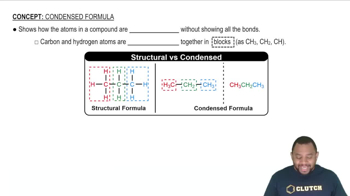
Condensed Structural Formula

A condensed structural formula is a way of representing a chemical compound that shows the arrangement of atoms and the connectivity between them without depicting all the bonds explicitly. It typically groups atoms together to indicate how they are bonded, making it easier to visualize the structure of the molecule in a compact form.
Recommended video:
Guided course
1:53
Condensed Formula Concept 1

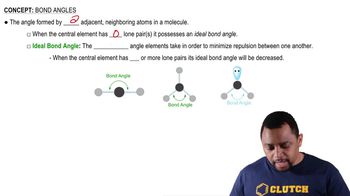
Line-Angle Formula

A line-angle formula, also known as a skeletal formula, is a simplified representation of a chemical structure where vertices represent carbon atoms and lines represent bonds. This method omits hydrogen atoms attached to carbons, making it easier to visualize complex organic molecules while focusing on the carbon backbone and functional groups.
Recommended video:
Guided course
01:24
Bond Angles (Simplified) Concept 1

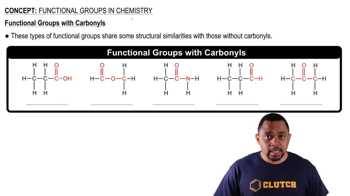
Ester Functional Group

An ester functional group is characterized by the presence of a carbonyl group (C=O) adjacent to an ether group (C-O-C). In the case of propyl benzoate, the ester is formed from benzoic acid and propanol, where the carboxylic acid group of benzoic acid reacts with the alcohol group of propanol, resulting in a compound that has distinct properties and applications in organic chemistry.
Recommended video:
Guided course
1:32
Functional Groups with Carbonyls Concept 3