Pearson+ LogoPearson+ Logo
Ch.13 Carbohydrates
Timberlake - Chemistry: An Introduction to General, Organic, and Biological Chemistry 14th Edition
Timberlake14thChemistry: An Introduction to General, Organic, and Biological ChemistryISBN: 9781292472249Not the one you use?Change textbook
Chapter 13, Problem 64b

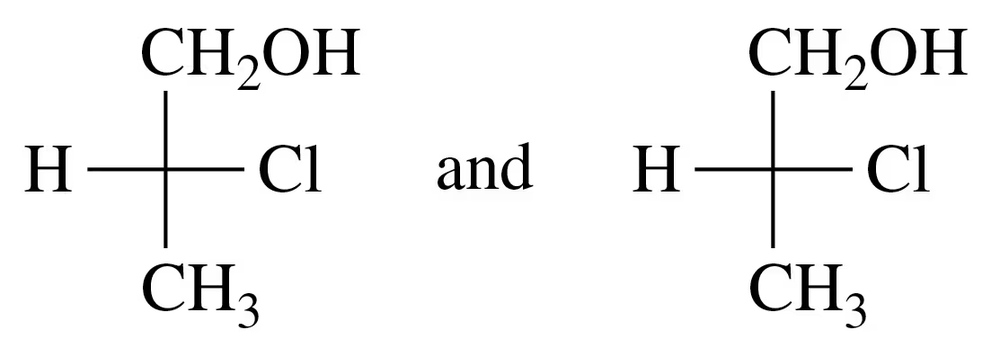
 Identify each of the following pairs of Fischer projections as enantiomers or identical compounds:
c. Fischer projections of two compounds labeled as "H, CH2OH, Cl, CH3" and "H, CH2OH, Cl, CH3" for comparison.

Verified step by step guidance
1
Examine the Fischer projections carefully. Fischer projections are a two-dimensional representation of molecules where the horizontal lines represent bonds projecting out of the plane (toward the viewer), and the vertical lines represent bonds projecting into the plane (away from the viewer).
Identify the chiral centers in each molecule. A chiral center is a carbon atom bonded to four different groups. Note the arrangement of the substituents around each chiral center.
Compare the configuration of the substituents at each chiral center in the two Fischer projections. If the substituents are arranged in opposite configurations (R vs. S) at all chiral centers, the molecules are enantiomers. If the configurations are identical at all chiral centers, the molecules are identical.
Check for any symmetry in the Fischer projections. If the molecules are mirror images of each other but not superimposable, they are enantiomers. If they are superimposable, they are identical compounds.
Conclude whether the given Fischer projections represent enantiomers or identical compounds based on your analysis of the chiral centers and symmetry.

Verified video answer for a similar problem:

This video solution was recommended by our tutors as helpful for the problem above.
Video duration:
2m
Was this helpful?

Key Concepts

Here are the essential concepts you must grasp in order to answer the question correctly.

Fischer Projections

Fischer projections are a two-dimensional representation of three-dimensional organic molecules, particularly useful for depicting stereochemistry. In these diagrams, vertical lines represent bonds that extend away from the viewer, while horizontal lines represent bonds that come towards the viewer. This format is especially helpful for visualizing the spatial arrangement of substituents around chiral centers.
Recommended video:
Guided course
0:48
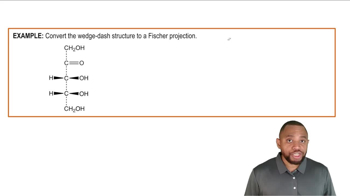
Fischer Projections Example 1

Enantiomers

Enantiomers are a type of stereoisomer that are non-superimposable mirror images of each other. They typically arise from molecules that contain one or more chiral centers, where the arrangement of atoms differs in a way that cannot be aligned with its mirror image. Enantiomers often exhibit different optical activities, meaning they rotate plane-polarized light in opposite directions.
Recommended video:
Guided course
3:33
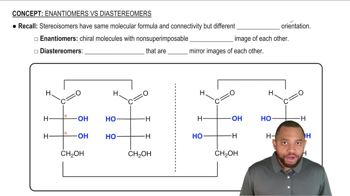
Enantiomers vs Diastereomers Concept 1

Identical Compounds

Identical compounds refer to molecules that have the same molecular formula and structural arrangement, resulting in the same physical and chemical properties. Unlike enantiomers, identical compounds can be superimposed on one another without any differences in their spatial arrangement. Recognizing identical compounds is crucial in stereochemistry to differentiate them from stereoisomers.
Recommended video:
Guided course
02:11
Naming Ionic Compounds