Pearson+ LogoPearson+ Logo
Ch.14 Carboxylic Acids, Esters, Amines, and Amides
Timberlake - Chemistry: An Introduction to General, Organic, and Biological Chemistry 13th Edition
Timberlake13th EditionChemistry: An Introduction to General, Organic, and Biological ChemistryISBN: 9780134421353Not the one you use?Change textbook
Chapter 14, Problem 34c

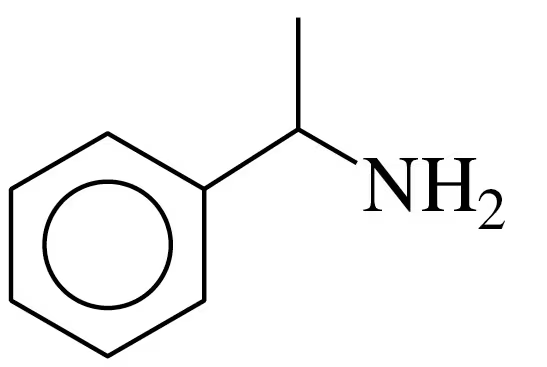
Classify each of the following amines as primary (1°), secondary (2°), or tertiary (3°):
c. Chemical structure of an amine with a benzene ring and an amino group (NH2) attached, indicating a primary amine.

Verified step by step guidance
1
Examine the structure of the amine provided in the image. Identify the nitrogen atom and count the number of carbon atoms directly bonded to it.
Recall the classification of amines: a primary (1°) amine has one carbon atom bonded to the nitrogen, a secondary (2°) amine has two carbon atoms bonded to the nitrogen, and a tertiary (3°) amine has three carbon atoms bonded to the nitrogen.
Determine the number of hydrogen atoms attached to the nitrogen. A primary amine will have two hydrogens, a secondary amine will have one hydrogen, and a tertiary amine will have no hydrogens attached to the nitrogen.
Use the information from steps 2 and 3 to classify the amine. If the nitrogen is bonded to one carbon and two hydrogens, it is primary. If bonded to two carbons and one hydrogen, it is secondary. If bonded to three carbons and no hydrogens, it is tertiary.
Verify your classification by double-checking the structure in the image and ensuring the bonding pattern matches the definition of the amine type you identified.

Verified video answer for a similar problem:

This video solution was recommended by our tutors as helpful for the problem above.
Video duration:
2m
Was this helpful?

Key Concepts

Here are the essential concepts you must grasp in order to answer the question correctly.

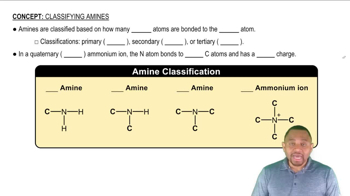
Amines Classification

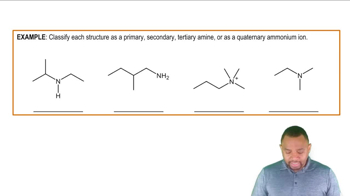
Amines are classified based on the number of carbon-containing groups attached to the nitrogen atom. A primary amine (1°) has one carbon group, a secondary amine (2°) has two, and a tertiary amine (3°) has three. This classification is crucial for understanding the reactivity and properties of amines in organic chemistry.
Recommended video:
Guided course
1:26
Amine Classification Concept 1

Structural Representation

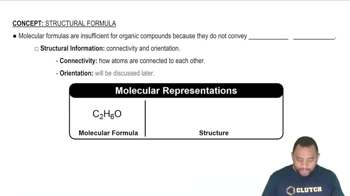
Understanding the structural representation of amines is essential for classification. The structure typically includes a nitrogen atom bonded to hydrogen and carbon atoms. Visualizing these structures helps in identifying the type of amine by counting the number of carbon groups attached to the nitrogen.
Recommended video:
Guided course
2:08
Molecular Representations Concept 1

Nomenclature of Amines

The nomenclature of amines involves naming them based on the number of carbon groups and the position of the nitrogen atom. This includes using prefixes like 'ethyl' or 'methyl' to denote the carbon groups. Familiarity with these naming conventions aids in accurately classifying and communicating about different amines.
Recommended video:
Guided course
0:54
Amine Classification Example 1