A man, J.B., has a sister with autosomal recessive galactosemia (OMIM 230400), and his partner, S.B., has a brother with galactosemia. Galactosemia is a serious condition caused by an enzyme deficiency that prevents the metabolism of the sugar galactose. Neither J.B. nor S.B. has galactosemia, but they are concerned about the risk that a future child of theirs will have the condition. What is the probability their first child will have galactosemia?

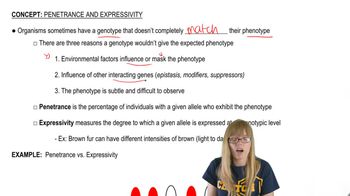
A 40-year-old woman whose father had Huntington disease currently shows no symptoms of the disease. She is newly pregnant with her first child and seeks your best estimate of the chance her child will inherit the disease. What is your estimate and how did you arrive at it? (Hint: See Figure 4.11)
Verified step by step guidance
Verified video answer for a similar problem:
Key Concepts
Autosomal Dominant Inheritance
Penetrance and Age of Onset
Risk Estimation Using Family History and Genetic Testing
Two parents plan to have three children. What is the probability that the children will be two girls and one boy?
A woman, S.R., had a maternal grandfather with hemophilia A (OMIM 306700), an X-linked recessive condition that reduces blood clotting. S.R.'s maternal grandmother and paternal grandparents are free of the condition, as are her partner, his parents, and his grandparents. S.R. has no siblings. She wants to know the chance that a son of hers will have the condition. What is that probability?
Consider the cross AaBbCC × AABbCc.
How many different gamete genotypes can each organism produce?
Consider the cross AaBbCC × AABbCc.
Use a Punnett square to predict the expected ratio of offspring phenotypes.
Consider the cross AaBbCC × AABbCc.
Use the forked-line method to predict the expected ratio of offspring phenotypes.
