Pearson+ LogoPearson+ Logo
Ch. 14 - Analysis of Gene Function via Forward Genetics and Reverse Genetics
Sanders - Genetic Analysis: An Integrated Approach 3rd Edition
Sanders3rd EditionGenetic Analysis: An Integrated ApproachISBN: 9780135564172Not the one you use?Change textbook
Chapter 14, Problem 4

Using the data in Table B, calculate the average number of kilobase (kb) pairs per centimorgan in the six multicellular eukaryotic organisms. How would this information influence strategies to clone genes known only by a mutant phenotype in these organisms?
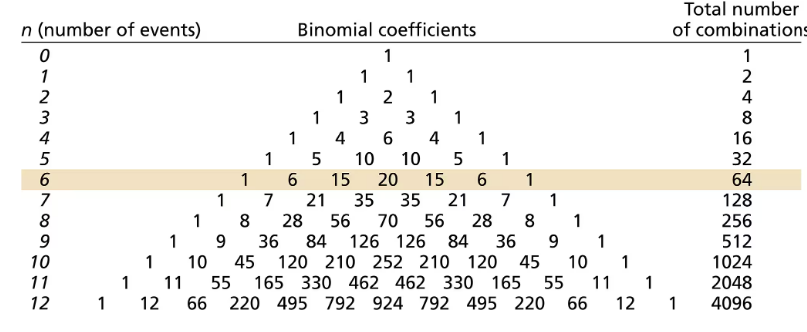
Table displaying binomial coefficients for events 0 to 12, highlighting the row for 6 events with total combinations of 64.

Verified step by step guidance
1
Identify the data provided in Table B for the six multicellular eukaryotic organisms, specifically the total genome size in kilobases (kb) and the total genetic map length in centimorgans (cM).
For each organism, calculate the average number of kilobase pairs per centimorgan by dividing the total genome size (in kb) by the total genetic map length (in cM). Use the formula: Genome Size (kb)Genetic Map Length (cM).
Once the calculations are complete for all six organisms, compute the overall average by summing the individual averages and dividing by the number of organisms (6 in this case).
Interpret the calculated average kb/cM values to understand the physical distance represented by 1 cM in these organisms. This provides insight into the resolution of genetic mapping in each organism.
Discuss how the kb/cM values influence gene cloning strategies. For example, organisms with a higher kb/cM ratio may require more extensive physical mapping or sequencing to identify genes associated with mutant phenotypes, while organisms with a lower kb/cM ratio may allow for more precise localization of genes.

Verified video answer for a similar problem:

This video solution was recommended by our tutors as helpful for the problem above.
Video duration:
2m
Was this helpful?

Key Concepts

Here are the essential concepts you must grasp in order to answer the question correctly.

Kilobase (kb) and Centimorgan (cM)

Kilobase (kb) is a unit of measurement in genetics that represents 1,000 base pairs of DNA. A centimorgan (cM) is a unit of genetic linkage that reflects the frequency of recombination between two loci on a chromosome, with 1 cM corresponding to a 1% chance of recombination occurring. Understanding the relationship between kb and cM is crucial for mapping genes and estimating genetic distances.
Recommended video:
Guided course
07:39
Genetic Cloning

Gene Cloning

Gene cloning is a molecular biology technique used to create copies of a specific gene or DNA segment. This process often involves isolating the gene of interest, inserting it into a vector, and introducing it into a host organism for replication. Knowledge of genetic distances, such as kb per cM, can inform strategies for identifying and isolating genes associated with specific phenotypes, especially in organisms where the gene is not directly observable.
Recommended video:
Guided course
07:
Positional Cloning

Mutant Phenotype

A mutant phenotype refers to a visible or measurable change in an organism's traits resulting from a mutation in its DNA. These phenotypes can provide clues about the underlying genetic changes and are often used in research to identify and study specific genes. Understanding the relationship between mutant phenotypes and their corresponding genetic loci is essential for developing effective gene cloning strategies in multicellular eukaryotes.
Recommended video:
Guided course
10:48
Mutations and Phenotypes
Related Practice
Textbook Question

Discuss the similarities and differences between forward and reverse genetic approaches, and when you would choose to utilize each of the approaches.

2
views
Textbook Question

Go to the National Institute for Child Health and Human Development (http://www.nichd.nih.gov), locate the search box at the top right corner of the homepage, and enter 'RUSP' to search for information on the Recommended Uniform Screening Panel. From the options that appear, select 'Brief History of Newborn Screening' and locate the discussion listing the criteria for adding a disease to the RUSP list. What are the criteria for listing a disease on the RUSP list?

3
views
Textbook Question

For the retinal cancer retinoblastoma, the inheritance of one mutated copy of RB1 from one of the parents is often referred to as a mutation that produces a 'dominant predisposition to cancer.' This means that the first mutation does not produce cancer but makes it very likely that cancer will develop.

Explain why cancer is almost certain to develop with the inheritance of one mutated copy of RB1.

Textbook Question

What are community-based genetic screening programs? What is the intent of such screening programs? Why are members of specific communities or populations offered the chance to participate in such programs?

Textbook Question

Explain the following processes involving chromosome mutations and cancer development.

How the chromosome mutation producing Burkitt lymphoma generates the disease.

Textbook Question

Explain the following processes involving chromosome mutations and cancer development.

How the chromosome mutation producing the Philadelphia chromosome leads to CML.