Pearson+ LogoPearson+ Logo
Ch. 14 - Analysis of Gene Function via Forward Genetics and Reverse Genetics
Sanders - Genetic Analysis: An Integrated Approach 3rd Edition
Sanders3rd EditionGenetic Analysis: An Integrated ApproachISBN: 9780135564172Not the one you use?Change textbook
Chapter 14, Problem C.8a

The inheritance of certain mutations of BRCA1 can make it much more likely that a woman will develop breast or ovarian cancer in her lifetime. Can you say with certainty that a woman inheriting a mutation of BRCA1 will definitely develop breast or ovarian cancer in her lifetime? Why or why not?

Verified step by step guidance
1
Understand that inheriting a mutation in the BRCA1 gene increases the risk of developing breast or ovarian cancer, but it does not guarantee that cancer will develop. This is because BRCA1 mutations are considered risk factors, not deterministic causes.
Recognize the concept of penetrance in genetics, which refers to the proportion of individuals with a particular genetic mutation who actually express the associated trait or disease. BRCA1 mutations have incomplete penetrance.
Consider environmental factors, lifestyle, and other genetic factors that can influence whether a woman with a BRCA1 mutation will develop cancer. These factors interact with the mutation to affect cancer risk.
Note that genetic counseling and testing provide probabilities or risk assessments rather than certainties, reflecting the complex nature of gene-environment interactions.
Summarize that while a BRCA1 mutation significantly raises the likelihood of cancer, it is not a definitive predictor, so a woman inheriting the mutation may or may not develop breast or ovarian cancer during her lifetime.

Verified video answer for a similar problem:

This video solution was recommended by our tutors as helpful for the problem above.
Video duration:
2m
Was this helpful?

Key Concepts

Here are the essential concepts you must grasp in order to answer the question correctly.

BRCA1 Gene and Its Role

BRCA1 is a gene that produces proteins responsible for repairing DNA damage. Mutations in BRCA1 can impair this repair process, increasing the risk of developing breast and ovarian cancers. However, not all mutations have the same effect, and the presence of a mutation raises risk but does not guarantee cancer.
Recommended video:
Guided course
11:19
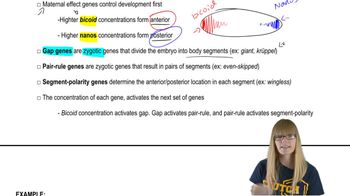
Segmentation Genes

Genetic Penetrance

Penetrance refers to the proportion of individuals with a specific genetic mutation who actually express the associated trait or disease. In the case of BRCA1 mutations, penetrance is incomplete, meaning some women with the mutation may never develop cancer, while others do, due to various genetic and environmental factors.
Recommended video:
Guided course
02:09
Penetrance and Expressivity

Risk Factors and Multifactorial Inheritance

Cancer development is influenced by multiple factors beyond a single gene mutation, including lifestyle, environment, and other genetic variations. Thus, inheriting a BRCA1 mutation increases risk but does not act alone, making cancer a multifactorial disease where risk is probabilistic, not deterministic.
Recommended video:
Guided course
05:13
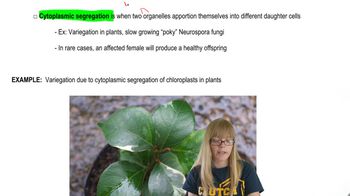
Organelle Inheritance