Radiation is frequently used as part of the treatment of cancer. The radiation works by damaging DNA and components of the cell. How can radiation treatment control or cure cancer?
Ch. 14 - Analysis of Gene Function via Forward Genetics and Reverse Genetics

Sanders3rd EditionGenetic Analysis: An Integrated ApproachISBN: 9780135564172Not the one you use?Change textbook
All textbooks
Sanders 3rd Edition
Ch. 14 - Analysis of Gene Function via Forward Genetics and Reverse Genetics
Problem C.7c
Sanders 3rd Edition
Ch. 14 - Analysis of Gene Function via Forward Genetics and Reverse Genetics
Problem C.7cChapter 14, Problem C.7c
Based on what you read in this chapter, Can a tumor arise from a single mutated cell? Are all the cells in a tumor identical?
Verified step by step guidance1
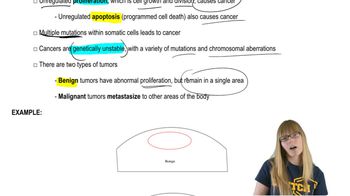
Understand the concept of tumorigenesis: Tumors often originate from a single cell that has undergone mutations leading to uncontrolled cell division. This mutated cell proliferates, giving rise to a mass of cells.
Recognize that the initial mutation in one cell can cause it to divide abnormally, forming a clonal population of cells derived from that original mutated cell.
Consider that as the tumor grows, additional mutations can occur in different cells within the tumor, leading to genetic diversity among the tumor cells.
Therefore, not all cells in a tumor are identical; they can have different mutations and characteristics due to ongoing genetic changes during tumor progression.
Summarize that a tumor can indeed arise from a single mutated cell, but the cells within the tumor are typically heterogeneous because of subsequent mutations and selection.

Verified video answer for a similar problem:
This video solution was recommended by our tutors as helpful for the problem above.
Video duration:
3mWas this helpful?
Key Concepts
Here are the essential concepts you must grasp in order to answer the question correctly.
Clonal Origin of Tumors
Tumors often arise from a single mutated cell that undergoes uncontrolled division, leading to a mass of cells with a common ancestor. This concept explains how one initial genetic alteration can initiate tumor formation.
Recommended video:
Guided course
Cancer Characteristics
Genetic Heterogeneity in Tumors
Although tumors may start from one cell, subsequent mutations during cell division create genetic diversity among tumor cells. This heterogeneity affects tumor behavior, treatment response, and progression.
Recommended video:
Guided course
Descriptive Genetics
Mutation and Cell Proliferation
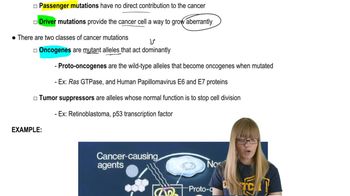
Mutations in genes regulating cell growth and division can cause cells to proliferate abnormally. Understanding how mutations disrupt normal cell cycle control is key to explaining tumor development and diversity.
Recommended video:
Guided course
Cancer Mutations
Related Practice
Textbook Question
Textbook Question
Diagram the mechanism by which CRISPR–Cas functions in the immune system of bacteria and archaea.
Textbook Question
Why do most cancers require the mutation of multiple genes?
Textbook Question
Describe how CRISPR–Cas has been modified to create a genome-editing tool.
Textbook Question
Do you think it is important that participation in community-based genetic screening be entirely voluntary? Why or why not?
Textbook Question
The inheritance of certain mutations of BRCA1 can make it much more likely that a woman will develop breast or ovarian cancer in her lifetime. Can you say with certainty that a woman inheriting a mutation of BRCA1 will definitely develop breast or ovarian cancer in her lifetime? Why or why not?
1
views