Radiation is frequently used as part of the treatment of cancer. The radiation works by damaging DNA and components of the cell. Is there a risk of damage to noncancer cells?
Ch. 14 - Analysis of Gene Function via Forward Genetics and Reverse Genetics

Sanders3rd EditionGenetic Analysis: An Integrated ApproachISBN: 9780135564172Not the one you use?Change textbook
All textbooks
Sanders 3rd Edition
Ch. 14 - Analysis of Gene Function via Forward Genetics and Reverse Genetics
Problem C.7b
Sanders 3rd Edition
Ch. 14 - Analysis of Gene Function via Forward Genetics and Reverse Genetics
Problem C.7bChapter 14, Problem C.7b
Why do most cancers require the mutation of multiple genes?
Verified step by step guidance1
Understand that cancer is a complex disease characterized by uncontrolled cell growth and division, which results from genetic mutations affecting cellular functions.
Recognize that multiple genes are involved in regulating cell cycle, DNA repair, apoptosis (programmed cell death), and other critical cellular processes that maintain normal cell behavior.
Identify that mutations in a single gene are often insufficient to cause cancer because cells have redundant and overlapping mechanisms to prevent abnormal growth.
Learn that for a cell to become cancerous, mutations typically need to accumulate in several key types of genes, such as oncogenes (which promote cell division when activated) and tumor suppressor genes (which inhibit cell division or promote apoptosis when functioning properly).
Conclude that the requirement for multiple gene mutations arises because cancer development involves overcoming multiple cellular safeguards, and only the combined effect of these mutations leads to the loss of normal growth control.

Verified video answer for a similar problem:
This video solution was recommended by our tutors as helpful for the problem above.
Video duration:
1mWas this helpful?
Key Concepts
Here are the essential concepts you must grasp in order to answer the question correctly.
Multistep Nature of Cancer Development
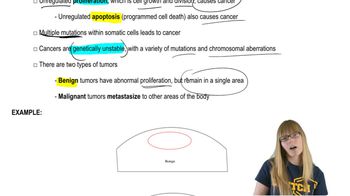
Cancer typically arises through a series of genetic changes rather than a single mutation. Multiple mutations accumulate over time, each contributing to the transformation of normal cells into malignant ones by disrupting various cellular processes.
Recommended video:
Guided course
Cancer Characteristics
Oncogenes and Tumor Suppressor Genes
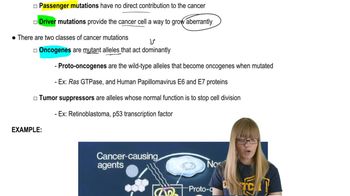
Cancer involves mutations in oncogenes, which promote cell growth, and tumor suppressor genes, which inhibit growth or repair DNA. Both types of genes must be altered to override normal cell regulation and allow uncontrolled proliferation.
Recommended video:
Guided course
Mapping Genes
Genetic Instability and Mutation Accumulation
Genetic instability in cells increases mutation rates, enabling the accumulation of multiple gene mutations. This instability is crucial for cancer progression, as it allows cells to acquire the diverse mutations needed to evade growth controls and resist cell death.
Recommended video:
Guided course
Cancer Mutations
Related Practice
Textbook Question
Textbook Question
Radiation is frequently used as part of the treatment of cancer. The radiation works by damaging DNA and components of the cell. How can radiation treatment control or cure cancer?
Textbook Question
Diagram the mechanism by which CRISPR–Cas functions in the immune system of bacteria and archaea.
Textbook Question
Based on what you read in this chapter, Can a tumor arise from a single mutated cell? Are all the cells in a tumor identical?
Textbook Question
Describe how CRISPR–Cas has been modified to create a genome-editing tool.
Textbook Question
Do you think it is important that participation in community-based genetic screening be entirely voluntary? Why or why not?