Back
Back
Problem 45
Solve each polynomial inequality. Give the solution set in interval notation. x5 + x2 + 2 ≥ x4 + x3 + 2x
Problem 46
If the given term is the dominating term of a polynomial function, what can we conclude about each of the following features of the graph of the function? (a) domain (b) range (c) end behavior (d) number of zeros (e) number of turning points -9x6
Problem 46
Give the equations of any vertical, horizontal, or oblique asymptotes for the graph of each rational function. ƒ(x)=(4x2+25)/(x2+9)
Problem 46
Graph each polynomial function. Factor first if the polynomial is not in factored form. ƒ(x)=x4+3x3-3x2-11x-6
Problem 47
Use synthetic division to determine whether the given number k is a zero of the polynomial function. If it is not, give the value of ƒ(k). ƒ(x) = x2 +2x -8; k=2
Problem 47
Graph each polynomial function. ƒ(x)=(x-2)2(x+3)
Problem 47
Solve each polynomial inequality. Give the solution set in interval notation. x4 + 6x2 + 1 ≥ 4x3 + 4x
Problem 47
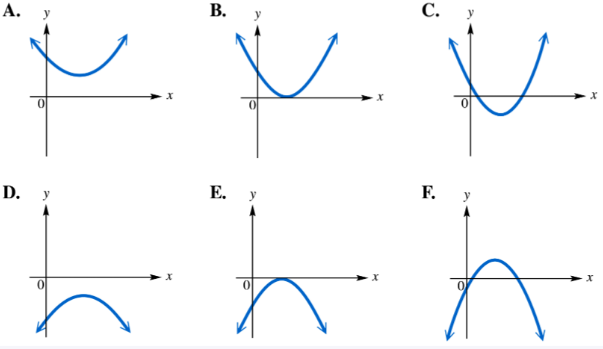
Several graphs of the quadratic function ƒ(x) = ax2 + bx + c are shown below. For the given restrictions on a, b, and c, select the corresponding graph from choices A–F. (Hint: Use the discriminant.) a < 0; b2 - 4ac < 0
Problem 48
Use the intermediate value theorem to show that each polynomial function has a real zero between the numbers given. ƒ(x)=3x2-x-4; 1 and 2
Problem 48
For each polynomial function, find all zeros and their multiplicities.
Problem 49
Graph each polynomial function. ƒ(x)=2x3+x2-x
Problem 49
Use the intermediate value theorem to show that each polynomial function has a real zero between the numbers given. ƒ(x)=-2x3+5x2+5x-7; 0 and 1
Problem 49
Use synthetic division to determine whether the given number k is a zero of the polynomial function. If it is not, give the value of ƒ(k). ƒ(x) = x3 - 3x2 + 4x -4; k=2
Problem 49
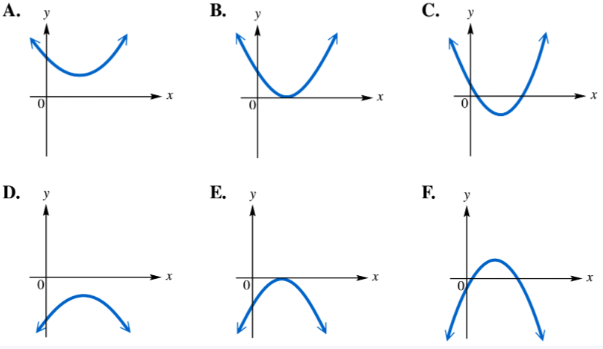
Several graphs of the quadratic function ƒ(x) = ax2 + bx + c are shown below. For the given restrictions on a, b, and c, select the corresponding graph from choices A–F. (Hint: Use the discriminant.) A > 0; b2 - 4ac > 0
Problem 49
For each polynomial function, find all zeros and their multiplicities.
Problem 50
Nuclear Bomb Detonation Suppose the effects of detonating a nuclear bomb will be felt over a distance from the point of detonation that is directly proportional to the cube root of the yield of the bomb. Suppose a 100-kiloton bomb has certain effects to a radius of 3 km from the point of detonation. Find, to the nearest tenth, the distance over which the effects would be felt for a 1500-kiloton bomb.
Problem 50
For each polynomial function, find all zeros and their multiplicities. ƒ(x)=5x2(x2-16)(x+5)
Problem 50a
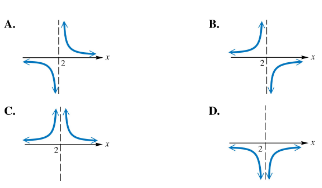
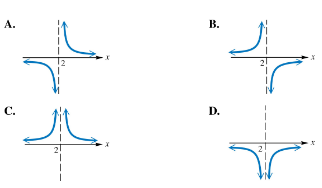
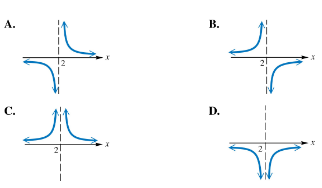
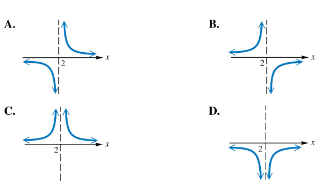
Work each problem. Choices A–D below show the four ways in which the graph of a rational function can approach the vertical line x=2 as an asymptote. Identify the graph of each rational function defined in parts (a) – (d). ƒ(x)=1/(x-2)^2
Problem 50b
Work each problem. Choices A–D below show the four ways in which the graph of a rational function can approach the vertical line x=2 as an asymptote. Identify the graph of each rational function defined in parts (a) – (d).
Problem 50c
Work each problem. Choices A–D below show the four ways in which the graph of a rational function can approach the vertical line x=2 as an asymptote. Identify the graph of each rational function defined in parts (a) – (d).
Problem 50d
Work each problem. Choices A–D below show the four ways in which the graph of a rational function can approach the vertical line x=2 as an asymptote. Identify the graph of each rational function defined in parts (a) – (d).
Problem 51
For each polynomial function, find all zeros and their multiplicities.
Problem 51
Use synthetic division to determine whether the given number k is a zero of the polynomial function. If it is not, give the value of ƒ(k). ƒ(x) = 2x3 - 6x2 -9x + 4; k=1
Problem 51
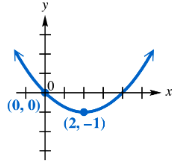
Connecting Graphs with Equations Find a quadratic function f having the graph shown. (Hint: See the Note following Example 3.)
Problem 51
Use the intermediate value theorem to show that each polynomial function has a real zero between the numbers given. ƒ(x)=2x4-4x2+4x-8; 1 and 2
Problem 51
Work each problem. Which function has a graph that does not have a vertical asymptote?
A. ƒ(x)=1/(x2+2)
B. ƒ(x)=1/(x2-2)
C. ƒ(x)=3/x2
D. ƒ(x)=(2x+1)/(x-8)
Problem 52
Use the intermediate value theorem to show that each polynomial function has a real zero between the numbers given. ƒ(x)=x4-4x3-x+3; 0.5 and 1
Problem 52
Work each problem. Which function has a graph that does not have a horizontal asymptote?
A. ƒ(x)=(2x-7)/(x+3)
B. ƒ(x)=3x/(x2-9)
C. ƒ(x)=(x2-9)/(x+3)
D. ƒ(x)=(x+5)/(x+2)(x-3)
Problem 52
For each polynomial function, find all zeros and their multiplicities.
Problem 52
Graph each polynomial function. ƒ(x)=-2x4+7x3-4x2-4x