Back
Back
Problem 71
Graph each rational function. See Examples 5–9.
Problem 72
Graph each rational function. ƒ(x)=[(x+3)(x-5)]/[(x+1)(x-4)]
Problem 72
Height of an Object If an object is projected upward from an initial height of 100 ft with an initial velocity of 64 ft per sec, then its height in feet after t seconds is given by . Find the number of seconds it will take the object to reach its maximum height. What is this maximum height?
Problem 73
Find a polynomial function ƒ(x) of least degree having only real coefficients and zeros as given. Assume multiplicity 1 unless otherwise stated. 2-i and 6-3i
Problem 73
Graph each rational function. ƒ(x)=(3x2+3x-6)/(x2-x-12)
Problem 73a
Solve each problem. Work each of the following. Sketch the graph of a function that does not intersect its horizontal asymptote y=1, has the line x=3 as a vertical asymptote, and has x-intercepts (2, 0) and (4, 0).
Problem 73b
Solve each problem. Work each of the following. Find an equation for a possible corresponding rational function.
Problem 74b
Solve each problem. Work each of the following. Find an equation for a possible corresponding rational function.
Problem 75
Graph each rational function. ƒ(x)=(9x2-1)/(x2-4)
Problem 75b
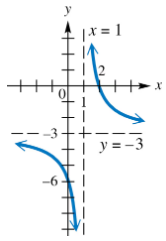
Solve each problem. Find a rational function ƒ having the graph shown.
Problem 76
Graph each rational function. See Examples 5–9.
Problem 76a
Solve each problem. This rational function has two holes and one vertical asymptote.
What are the x-values of the holes?
Problem 79
Solve each inequality. Give the solution set in interval notation. (2x-1)(x+5)<0
Problem 79
Determine the different possibilities for the numbers of positive, negative, and nonreal complex zeros of each function.
Problem 80
Determine the different possibilities for the numbers of positive, negative, and nonreal complex zeros of each function. See Example 7. ƒ(x)=x3+2x2+x-10
Problem 81
Determine the different possibilities for the numbers of positive, negative, and nonreal complex zeros of each function.
Problem 81
Solve each inequality. Give the solution set in interval notation. (x-4)(x-1)(x+2)>0
Problem 81
Find a value of c so that y = x2 - 10x + c has exactly one x-intercept.
Problem 82
For what values of a does y = ax2 - 8x + 4 have no x-intercepts?
Problem 82
Determine the different possibilities for the numbers of positive, negative, and nonreal complex zeros of each function.
Problem 82
Graph each rational function. ƒ(x)=[(x-5)(x-2)]/(x2+9)
Problem 83
Define the quadratic function ƒ having x-intercepts (2, 0) and (5, 0) and y-intercept (0, 5).
Problem 83
Use a graphing calculator to find the coordinates of the turning points of the graph of each polynomial function in the given domain interval. Give answers to the nearest hundredth. ƒ(x)=2x3-5x2-x+1; [-1, 0]
Problem 83
Graph each rational function. ƒ(x)=(x2+8x+16)/(x2+4x-5)
Problem 83
Determine the different possibilities for the numbers of positive, negative, and nonreal complex zeros of each function.
Problem 84
Graph each rational function. ƒ(x)=(x2+2x+1)/(x2-x-6)
Problem 84
Solve each inequality. Give the solution set in interval notation. (x+7)/(2x+1)<0
Problem 84
Define the quadratic function ƒ having x-intercepts (1, 0) and (-2, 0) and y-intercept (0, 4).
Problem 84
Determine the different possibilities for the numbers of positive, negative, and nonreal complex zeros of each function.
Problem 85
The distance between the two points and is . Distance formula. Find the closest point on the line to the point . (Hint: Every point on has the form , and the closest point has the minimum distance.)