Pearson+ LogoPearson+ Logo
Ch. 26 - Bacteria and Archaea
Freeman - Biological Science 8th Edition
Freeman8th EditionBiological ScienceISBN: 9780138276263Not the one you use?Change textbook
Chapter 26, Problem 11

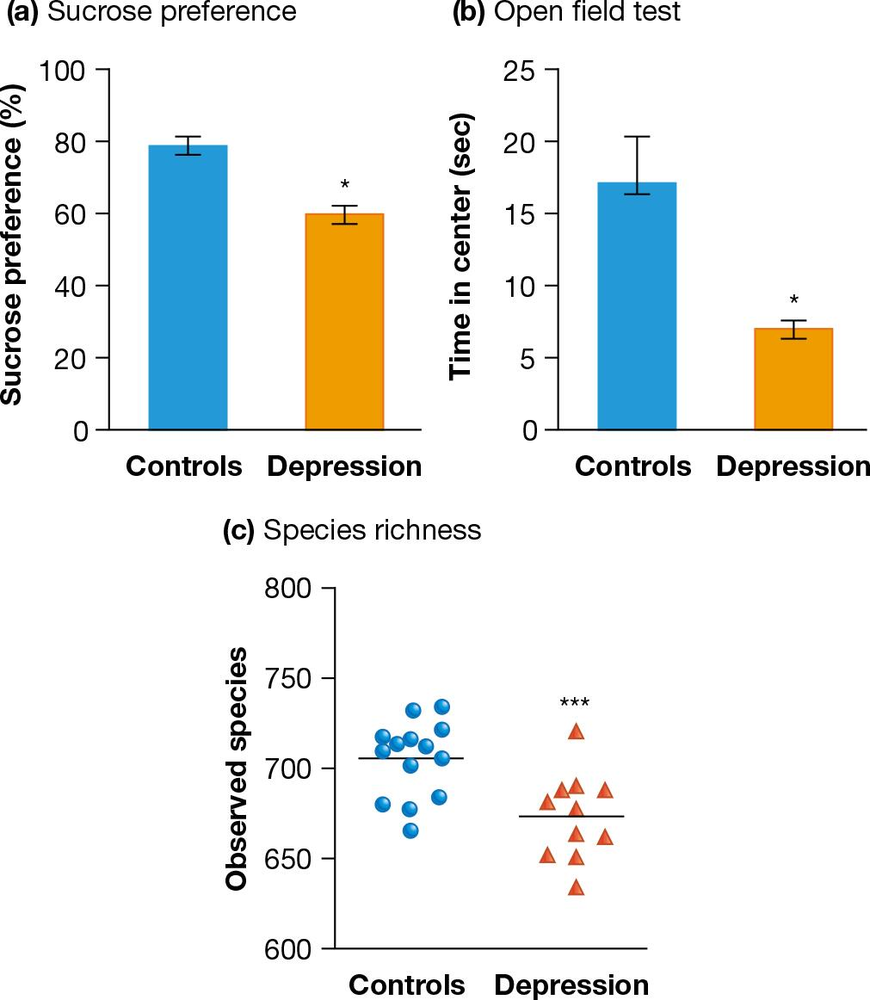
Researchers examined the relationship between gut microbiomes and depression. To do so, they collected fecal samples from people with depression and also a control group of individuals with no signs of depression. They then performed a fecal microbiota transfer (FMT) by adding the samples to rats that had no gut microbiota and examined behaviors associated with depression and anxiety as well as species of bacteria that ended up growing in the rats’ guts. The results are presented below. Graph (a) shows the rats’ interest in a pleasurable experience (drinking sugar water). Graph (b) shows the amount of time rats spent out in the open versus along the edge of an area (a sign of anxiety). Graph (c) shows the number of species observed in rats after FMT.


What conclusions can be drawn regarding the impact of FMT from depressed individuals on behaviors associated with depression and anxiety in rats?

Verified step by step guidance
1
Examine Graph (a) which shows sucrose preference in rats. Note that rats receiving FMT from depressed individuals show a lower sucrose preference compared to controls, indicating anhedonia, a symptom of depression.
Analyze Graph (b) which depicts the open field test results. Rats with FMT from depressed individuals spend less time in the center, suggesting increased anxiety-like behavior compared to controls.
Observe Graph (c) which illustrates species richness in the gut microbiota of rats. Rats receiving FMT from depressed individuals have a different species richness compared to controls, indicating a change in gut microbiota composition.
Conclude that FMT from depressed individuals induces depression-like and anxiety-like behaviors in rats, as evidenced by decreased sucrose preference and reduced time in the center of the open field test.
Infer that changes in gut microbiota composition, as shown by species richness differences, may be linked to the observed behavioral changes in rats.

Key Concepts

Here are the essential concepts you must grasp in order to answer the question correctly.

Gut Microbiome

The gut microbiome refers to the diverse community of microorganisms residing in the gastrointestinal tract. These microbes play a crucial role in digestion, metabolism, and immune function, and emerging research suggests they may also influence mental health. Changes in the composition of gut microbiota can affect neurotransmitter production and inflammation, potentially linking gut health to conditions like depression.
Recommended video:
Guided course
03:25
The Human Microbiome

Fecal Microbiota Transfer (FMT)

Fecal microbiota transfer (FMT) is a medical procedure that involves transferring fecal matter from a healthy donor to a recipient to restore a balanced gut microbiome. This technique has been studied for its potential to treat various conditions, including Clostridium difficile infections and, as indicated in the question, mental health disorders. FMT can alter the gut microbiome composition, which may lead to changes in behavior and mood.
Recommended video:
Guided course
04:42
Horizontal Gene Transfer

Behavioral Indicators of Depression and Anxiety

Behavioral indicators of depression and anxiety in animal models, such as rats, are often assessed through tests like the sucrose preference test and the open field test. The sucrose preference test measures an animal's interest in sweet solutions, with reduced preference indicating anhedonia, a common symptom of depression. The open field test evaluates anxiety by measuring the time spent in the center versus the edges of an arena, where less time in the center suggests increased anxiety.
Recommended video: