
What has metagenomic analysis allowed researchers to do for the first time? a. sample organisms from an environment and grow them under defined conditions in the lab b. isolate organisms from an environment and sequence their entire genome c. study organisms that cannot be cultured (grown in the lab) d. identify important morphological differences among species
Ch. 26 - Bacteria and Archaea
Chapter 26, Problem 9
Streptococcus mutans obtains energy by oxidizing sucrose. This bacterium is abundant in the mouths of Western European and North American children and is a prominent cause of cavities. The organism is virtually absent in children from East Africa, where tooth decay is rare. Propose a hypothesis to explain this observation. Outline the design of a study that would test your hypothesis.
Verified step by step guidance1
Step 1: Formulate a hypothesis based on the observation. A possible hypothesis could be: 'The absence of Streptococcus mutans in East African children is due to dietary differences, particularly lower consumption of sucrose, which reduces the bacterium's energy source and thus its prevalence and the incidence of cavities.'
Step 2: Design a study to test the hypothesis. Begin by selecting a sample of children from both Western Europe/North America and East Africa. Ensure that the sample is representative in terms of age, health status, and other relevant factors.
Step 3: Collect data on the children's diets, specifically focusing on sucrose intake. This could involve food frequency questionnaires, 24-hour dietary recalls, or direct observation of eating habits.
Step 4: Measure the prevalence of Streptococcus mutans in the mouths of the children using oral swabs followed by microbial culture techniques or molecular methods to identify and quantify the bacterium.
Step 5: Analyze the data to see if there is a correlation between sucrose intake and the presence of Streptococcus mutans, and subsequently, the incidence of cavities. Use statistical methods to determine if the differences observed are significant, while controlling for potential confounding factors.

Verified video answer for a similar problem:
This video solution was recommended by our tutors as helpful for the problem above.
Video duration:
2mWas this helpful?
Key Concepts
Here are the essential concepts you must grasp in order to answer the question correctly.
Metabolism of Streptococcus mutans
Streptococcus mutans is a bacterium that metabolizes sucrose through fermentation, producing lactic acid as a byproduct. This acid can demineralize tooth enamel, leading to cavities. Understanding its metabolic pathways is crucial for hypothesizing why its prevalence correlates with dental health in different populations.
Recommended video:
Guided course
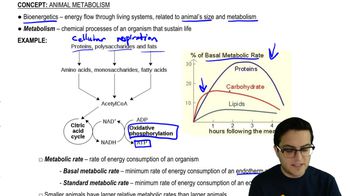
Metabolic Rate
Ecological Factors in Oral Microbiome
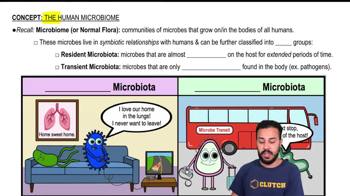
The oral microbiome consists of various microorganisms that interact with each other and their environment. Factors such as diet, hygiene practices, and cultural differences can influence the composition of this microbiome, potentially explaining the absence of S. mutans in certain populations and their lower incidence of cavities.
Recommended video:
Guided course
The Human Microbiome
Hypothesis Testing and Study Design
Formulating a hypothesis involves making a testable prediction based on observations. A well-designed study to test this hypothesis would include comparing dietary habits, oral hygiene practices, and the presence of S. mutans in different populations. This could involve cross-sectional surveys or longitudinal studies to establish causal relationships.
Recommended video:
Guided course
Test Crosses
Related Practice
Textbook Question
Textbook Question
Biologists often use the term 'energy source' as a synonym for 'electron donor.' Why?
Textbook Question
The text claims that the evolution of an oxygen-rich atmosphere paved the way for increasingly efficient cellular respiration and higher growth rates in organisms. Explain.
1
views
Textbook Question
Suppose that you've been hired by a firm interested in using bacteria to clean up organic solvents found in toxic waste dumps. Your new employer is particularly interested in finding cells that are capable of breaking a molecule called benzene into less-toxic compounds. Where would you go to look for bacteria that can metabolize benzene as an energy or carbon source? How would you design an enrichment culture capable of isolating benzene-metabolizing species?
