
Streptococcus mutans obtains energy by oxidizing sucrose. This bacterium is abundant in the mouths of Western European and North American children and is a prominent cause of cavities. The organism is virtually absent in children from East Africa, where tooth decay is rare. Propose a hypothesis to explain this observation. Outline the design of a study that would test your hypothesis.
Ch. 26 - Bacteria and Archaea
Chapter 26, Problem 12
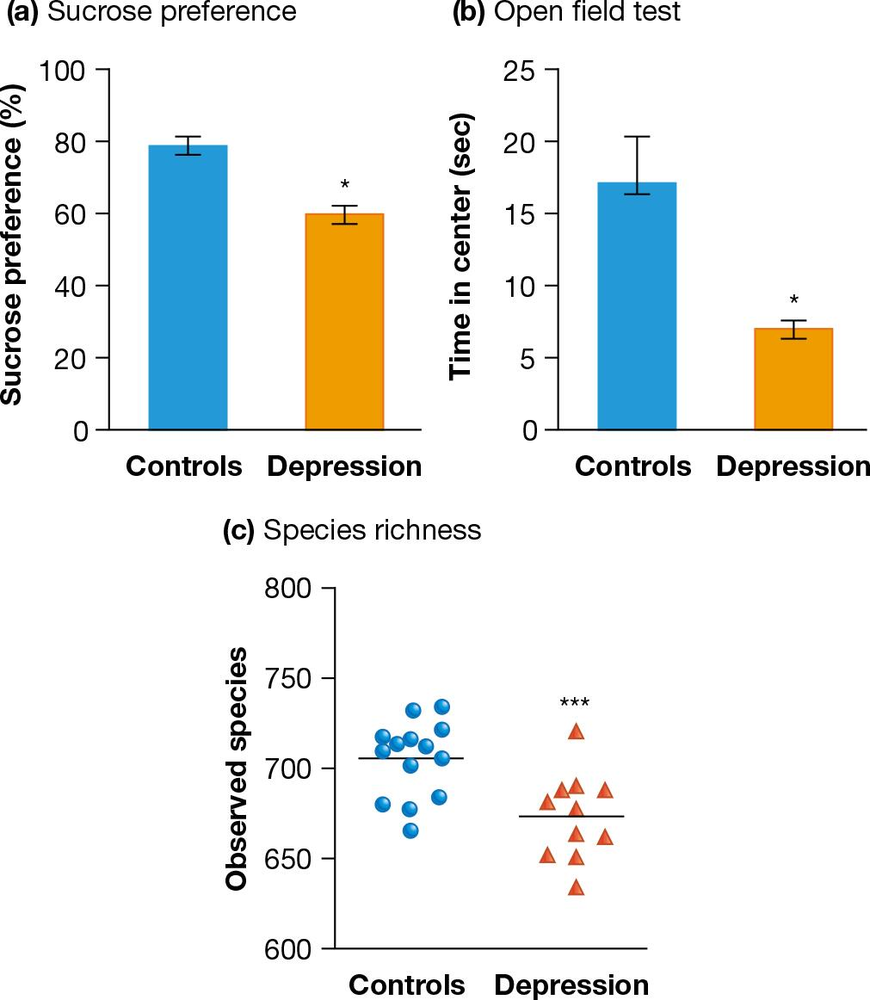
Researchers examined the relationship between gut microbiomes and depression. To do so, they collected fecal samples from people with depression and also a control group of individuals with no signs of depression. They then performed a fecal microbiota transfer (FMT) by adding the samples to rats that had no gut microbiota and examined behaviors associated with depression and anxiety as well as species of bacteria that ended up growing in the rats’ guts. The results are presented below. Graph (a) shows the rats’ interest in a pleasurable experience (drinking sugar water). Graph (b) shows the amount of time rats spent out in the open versus along the edge of an area (a sign of anxiety). Graph (c) shows the number of species observed in rats after FMT.

What conclusion can be drawn regarding the relationship between microbiome diversity and mental health in rats?
Verified step by step guidance1
Examine Graph (a) which shows the sucrose preference of rats. Note that rats with fecal microbiota from depressed individuals show a lower preference for sucrose compared to the control group.
Analyze Graph (b) which depicts the open field test results. Observe that rats with fecal microbiota from depressed individuals spend less time in the center, indicating higher anxiety levels compared to the control group.
Look at Graph (c) which illustrates species richness. Notice that the number of observed species in the gut microbiota of rats with fecal samples from depressed individuals is lower than that of the control group.
Combine the observations from all three graphs to understand the relationship between gut microbiome diversity and mental health. Lower species richness in the gut microbiota is associated with behaviors indicative of depression and anxiety in rats.
Conclude that there is a potential link between reduced gut microbiome diversity and negative mental health outcomes, as evidenced by the behavioral changes in rats receiving fecal microbiota from depressed individuals.
Key Concepts
Here are the essential concepts you must grasp in order to answer the question correctly.
Gut Microbiome
The gut microbiome refers to the diverse community of microorganisms residing in the gastrointestinal tract. These microbes play a crucial role in digestion, metabolism, and immune function, and emerging research suggests they may also influence mental health. Changes in the composition and diversity of gut bacteria can affect neurotransmitter production and inflammation, potentially impacting mood and behavior.
Recommended video:
Guided course
The Human Microbiome
Fecal Microbiota Transfer (FMT)
Fecal microbiota transfer (FMT) is a medical procedure that involves transferring fecal matter from a healthy donor to a recipient to restore a balanced gut microbiome. This technique is often used to treat conditions like Clostridium difficile infection but is also being explored for its potential effects on mental health. In the context of the study, FMT was used to investigate how gut microbiome diversity might influence behaviors associated with depression and anxiety in rats.
Recommended video:
Guided course
Horizontal Gene Transfer
Microbiome Diversity and Mental Health
Research indicates a correlation between microbiome diversity and mental health, suggesting that a more diverse gut microbiome may be protective against conditions like depression. The study's findings, illustrated in the graphs, show that rats receiving microbiota from depressed individuals exhibited reduced sucrose preference and increased anxiety, indicating that lower microbiome diversity may be linked to negative mental health outcomes. Understanding this relationship could lead to novel therapeutic approaches for mental health disorders.
Recommended video:
Guided course
The Human Microbiome
Related Practice
Textbook Question
Textbook Question
Suppose that you've been hired by a firm interested in using bacteria to clean up organic solvents found in toxic waste dumps. Your new employer is particularly interested in finding cells that are capable of breaking a molecule called benzene into less-toxic compounds. Where would you go to look for bacteria that can metabolize benzene as an energy or carbon source? How would you design an enrichment culture capable of isolating benzene-metabolizing species?
