An experiment is performed to test the effects of a new drug on attention-deficit/hyperactivity disorder (ADHD). The experimenter identifies 320 people ages 7 to 44 with ADHD to participate in the experiment. The subjects are divided into equal groups according to age. Within each group, subjects are then randomly selected to be in either the treatment group or the control group. What type of experimental design is being used for this experiment?
Table of contents
- 1. Intro to Stats and Collecting Data1h 14m
- 2. Describing Data with Tables and Graphs1h 55m
- 3. Describing Data Numerically2h 5m
- 4. Probability2h 16m
- 5. Binomial Distribution & Discrete Random Variables3h 6m
- 6. Normal Distribution and Continuous Random Variables2h 11m
- 7. Sampling Distributions & Confidence Intervals: Mean3h 23m
- Sampling Distribution of the Sample Mean and Central Limit Theorem19m
- Distribution of Sample Mean - Excel23m
- Introduction to Confidence Intervals15m
- Confidence Intervals for Population Mean1h 18m
- Determining the Minimum Sample Size Required12m
- Finding Probabilities and T Critical Values - Excel28m
- Confidence Intervals for Population Means - Excel25m
- 8. Sampling Distributions & Confidence Intervals: Proportion2h 10m
- 9. Hypothesis Testing for One Sample5h 8m
- Steps in Hypothesis Testing1h 6m
- Performing Hypothesis Tests: Means1h 4m
- Hypothesis Testing: Means - Excel42m
- Performing Hypothesis Tests: Proportions37m
- Hypothesis Testing: Proportions - Excel27m
- Performing Hypothesis Tests: Variance12m
- Critical Values and Rejection Regions28m
- Link Between Confidence Intervals and Hypothesis Testing12m
- Type I & Type II Errors16m
- 10. Hypothesis Testing for Two Samples5h 37m
- Two Proportions1h 13m
- Two Proportions Hypothesis Test - Excel28m
- Two Means - Unknown, Unequal Variance1h 3m
- Two Means - Unknown Variances Hypothesis Test - Excel12m
- Two Means - Unknown, Equal Variance15m
- Two Means - Unknown, Equal Variances Hypothesis Test - Excel9m
- Two Means - Known Variance12m
- Two Means - Sigma Known Hypothesis Test - Excel21m
- Two Means - Matched Pairs (Dependent Samples)42m
- Matched Pairs Hypothesis Test - Excel12m
- Two Variances and F Distribution29m
- Two Variances - Graphing Calculator16m
- 11. Correlation1h 24m
- 12. Regression3h 33m
- Linear Regression & Least Squares Method26m
- Residuals12m
- Coefficient of Determination12m
- Regression Line Equation and Coefficient of Determination - Excel8m
- Finding Residuals and Creating Residual Plots - Excel11m
- Inferences for Slope31m
- Enabling Data Analysis Toolpak1m
- Regression Readout of the Data Analysis Toolpak - Excel21m
- Prediction Intervals13m
- Prediction Intervals - Excel19m
- Multiple Regression - Excel29m
- Quadratic Regression15m
- Quadratic Regression - Excel10m
- 13. Chi-Square Tests & Goodness of Fit2h 21m
- 14. ANOVA2h 28m
1. Intro to Stats and Collecting Data
Intro to Stats
Problem 1.r.19
Textbook Question
Determine whether the study is an observational study or an experiment. Explain.
Researchers conduct a study to determine whether a medication based on fish oil known as omega-3 carboxylic acids is effective in reducing the risk of cardiac events in people already at risk. In the study, 13,078 patients are randomly chosen to receive either omega-3 carboxylic acids or a placebo of corn oil daily. Researchers compare the number of cardiac events of the two groups over similar follow-up periods of time. (Source: American Heart Association)
Verified step by step guidance1
Step 1: Understand the difference between an observational study and an experiment. An observational study involves observing and measuring variables without manipulating them, while an experiment involves actively assigning treatments to subjects to observe the effects of those treatments.
Step 2: Identify the key elements of the study described in the problem. In this case, researchers randomly assign 13,078 patients to one of two groups: one group receives omega-3 carboxylic acids, and the other group receives a placebo (corn oil).
Step 3: Note that the researchers are actively manipulating the treatment by assigning patients to receive either the medication or the placebo. This is a hallmark of an experimental study.
Step 4: Observe that the researchers are comparing the outcomes (number of cardiac events) between the two groups over similar follow-up periods. This comparison is used to determine the effect of the treatment.
Step 5: Conclude that this study is an experiment because the researchers are actively assigning treatments (omega-3 carboxylic acids or placebo) to the participants and observing the outcomes to determine the effect of the treatment.
Verified video answer for a similar problem:This video solution was recommended by our tutors as helpful for the problem above
Video duration:
3mPlay a video:
0 Comments
Key Concepts
Here are the essential concepts you must grasp in order to answer the question correctly.
Observational Study vs. Experiment
An observational study involves observing subjects without manipulating any variables, while an experiment involves the active intervention by researchers to test a hypothesis. In an experiment, participants are typically assigned to different groups to receive treatments or interventions, allowing for causal inferences.
Recommended video:
Guided course
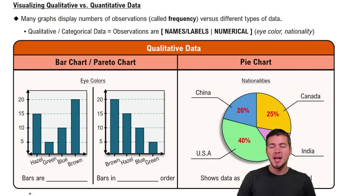
Visualizing Qualitative vs. Quantitative Data
Random Assignment
Random assignment is a technique used in experiments to allocate participants to different treatment groups randomly. This process helps ensure that each group is similar at the start of the study, minimizing biases and allowing researchers to attribute differences in outcomes directly to the treatment being tested.
Recommended video:
Guided course
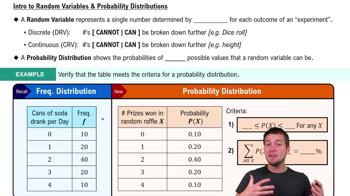
Intro to Random Variables & Probability Distributions
Control Group
A control group is a baseline group in an experiment that does not receive the treatment being tested, allowing researchers to compare outcomes against those who do receive the treatment. In this study, the placebo group receiving corn oil serves as the control group, helping to assess the effectiveness of the omega-3 carboxylic acids.
Recommended video:
Guided course
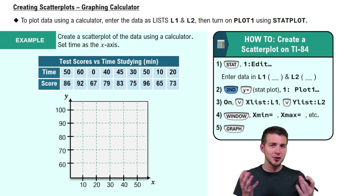
Creating Scatterplots - Graphing Calculator
Watch next
Master Introduction to Statistics Channel with a bite sized video explanation from Patrick
Start learningRelated Videos
Related Practice
Textbook Question
1
views