Technology In Exercises 9–12, test the given claim by using the display provided from technology. Use a 0.05 significance level. Identify the null and alternative hypotheses, test statistic, P-value (or range of P-values), or critical value(s), and state the final conclusion that addresses the original claim.
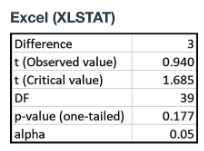
Tower of Terror Data Set 33 “Disney World Wait Times” includes wait times (minutes) for the Tower of Terror ride at 5:00 PM. Using the first 40 times to test the claim that the mean of all such wait times is more than 30 minutes, the accompanying Excel display is obtained.
Verified step by step guidance
1
Step 1: Identify the null hypothesis (H₀) and the alternative hypothesis (H₁). The null hypothesis is H₀: μ ≤ 30 (the mean wait time is 30 minutes or less), and the alternative hypothesis is H₁: μ > 30 (the mean wait time is more than 30 minutes). This is a one-tailed test.
Step 2: Determine the significance level (α). From the problem, α = 0.05.
Step 3: Locate the test statistic and critical value. From the Excel output, the test statistic (t observed) is 0.940, and the critical value (t critical) for a one-tailed test with 39 degrees of freedom is 1.685.
Step 4: Compare the test statistic to the critical value. If the test statistic is greater than the critical value, reject the null hypothesis. Otherwise, fail to reject the null hypothesis. Here, 0.940 < 1.685, so we fail to reject the null hypothesis.
Step 5: Interpret the p-value. The p-value is 0.177, which is greater than the significance level (0.05). This also supports the decision to fail to reject the null hypothesis. Conclude that there is not enough evidence to support the claim that the mean wait time is more than 30 minutes.
Verified video answer for a similar problem:
This video solution was recommended by our tutors as helpful for the problem above
Video duration:
5m
Play a video:
0 Comments
Key Concepts
Here are the essential concepts you must grasp in order to answer the question correctly.
Null and Alternative Hypotheses
In hypothesis testing, the null hypothesis (H0) represents a statement of no effect or no difference, while the alternative hypothesis (H1) suggests that there is an effect or a difference. In this case, the null hypothesis would state that the mean wait time is 30 minutes or less, while the alternative hypothesis would claim that the mean wait time is greater than 30 minutes.
The P-value is a statistical measure that helps determine the significance of the results from a hypothesis test. It represents the probability of obtaining test results at least as extreme as the observed results, assuming that the null hypothesis is true. A smaller P-value indicates stronger evidence against the null hypothesis. In this scenario, a P-value of 0.177 suggests that there is not enough evidence to reject the null hypothesis at the 0.05 significance level.
The significance level, denoted as alpha (α), is the threshold used to determine whether to reject the null hypothesis. It represents the probability of making a Type I error, which occurs when the null hypothesis is incorrectly rejected. In this case, an alpha of 0.05 means that there is a 5% risk of concluding that the mean wait time is greater than 30 minutes when it is not, guiding the decision-making process in hypothesis testing.