Pearson+ LogoPearson+ Logo
Ch.18 Metabolic Pathways and ATP Production
Timberlake - Chemistry: An Introduction to General, Organic, and Biological Chemistry 14th Edition
Timberlake14thChemistry: An Introduction to General, Organic, and Biological ChemistryISBN: 9781292472249Not the one you use?Change textbook
Chapter 18, Problem 74c

Arachidic acid is a C20 fatty acid found in peanut and fish oils.
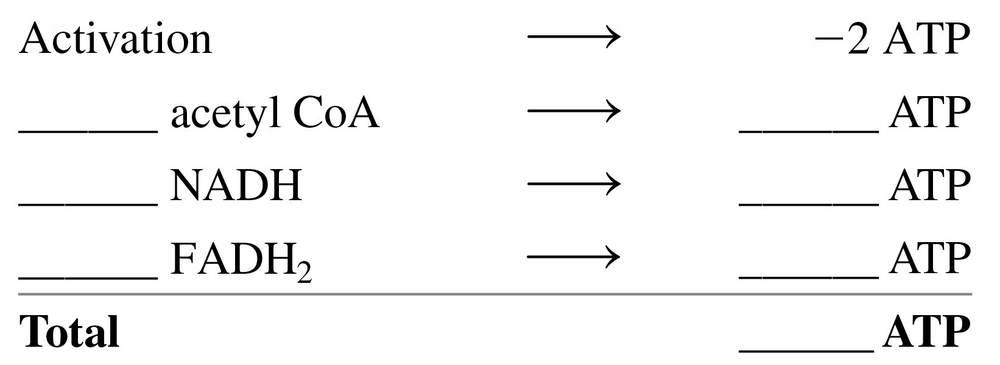
c. Calculate the total ATP yield from the complete β oxidation of arachidic acid by completing the following:
Diagram showing ATP yield calculations for fatty acid metabolism, including activation and products from acetyl CoA, NADH, and FADH2.

Verified step by step guidance
1
Step 1: Understand the structure of arachidic acid. Arachidic acid is a saturated fatty acid with the molecular formula C₂₀H₄₀O₂. This means it has 20 carbon atoms in its chain, and no double bonds.
Step 2: Determine the number of β-oxidation cycles. Each β-oxidation cycle shortens the fatty acid chain by 2 carbons, producing 1 acetyl-CoA molecule. For a 20-carbon fatty acid, the number of β-oxidation cycles is (20/2) - 1 = 9 cycles.
Step 3: Calculate the ATP yield from β-oxidation. Each β-oxidation cycle produces 1 FADH₂ and 1 NADH. Using the ATP equivalents (1 FADH₂ = 1.5 ATP, 1 NADH = 2.5 ATP), calculate the ATP yield from the 9 cycles: (9 × 1.5 ATP) + (9 × 2.5 ATP).
Step 4: Calculate the ATP yield from acetyl-CoA. Each acetyl-CoA enters the citric acid cycle, producing 3 NADH, 1 FADH₂, and 1 GTP (equivalent to 1 ATP). For 10 acetyl-CoA molecules (from 20 carbons), calculate the total ATP yield: (10 × 3 × 2.5 ATP) + (10 × 1 × 1.5 ATP) + (10 × 1 ATP).
Step 5: Subtract the ATP cost for activation. The activation of the fatty acid to form fatty acyl-CoA requires 2 ATP. Subtract this value from the total ATP yield calculated in the previous steps to determine the net ATP yield.

Verified video answer for a similar problem:

This video solution was recommended by our tutors as helpful for the problem above.
Video duration:
7m
Was this helpful?

Key Concepts

Here are the essential concepts you must grasp in order to answer the question correctly.

β-oxidation

β-oxidation is a metabolic process that breaks down fatty acids into acetyl-CoA units, which can then enter the citric acid cycle for energy production. This process occurs in the mitochondria and involves a series of enzymatic reactions that sequentially remove two-carbon units from the fatty acid chain, generating NADH and FADH2, which are crucial for ATP synthesis.

ATP yield

ATP yield refers to the total amount of adenosine triphosphate (ATP) produced from a biochemical process, such as the complete oxidation of fatty acids. In the context of β-oxidation, each cycle of the process generates reducing equivalents (NADH and FADH2) that contribute to the electron transport chain, ultimately leading to ATP production. Understanding how to calculate ATP yield is essential for evaluating the energy efficiency of fatty acid metabolism.
Recommended video:
Guided course
03:09
Percent Yield

fatty acid structure

The structure of fatty acids, including arachidic acid, is characterized by a long hydrocarbon chain with a carboxylic acid group at one end. Arachidic acid, specifically, is a saturated fatty acid with 20 carbon atoms. The structural properties of fatty acids influence their metabolic pathways, solubility, and energy content, making it important to consider when calculating ATP yield from their oxidation.
Recommended video:
Guided course
0:55
Fatty Acids Example 1