Pearson+ LogoPearson+ Logo
Ch.17 Nucleic Acids and Protein Synthesis
Timberlake - Chemistry: An Introduction to General, Organic, and Biological Chemistry 14th Edition
Timberlake14thChemistry: An Introduction to General, Organic, and Biological ChemistryISBN: 9781292472249Not the one you use?Change textbook
Chapter 17, Problem 9c

State whether each of the following components is present in DNA only, RNA only, or both DNA and RNA:
c. deoxycytidine monophosphate

Verified step by step guidance
1
Understand the structure of DNA and RNA: DNA (deoxyribonucleic acid) and RNA (ribonucleic acid) are nucleic acids composed of nucleotides. Each nucleotide consists of three components: a sugar, a phosphate group, and a nitrogenous base.
Identify the sugar in the nucleotide: DNA contains deoxyribose as its sugar, while RNA contains ribose. The key difference is that deoxyribose lacks an oxygen atom on the 2' carbon of the sugar ring, whereas ribose has a hydroxyl (-OH) group at this position.
Analyze the term 'deoxycytidine monophosphate': The prefix 'deoxy-' indicates the presence of deoxyribose as the sugar. 'Cytidine' refers to the nucleoside formed by cytosine (a nitrogenous base) attached to deoxyribose. 'Monophosphate' indicates that there is one phosphate group attached to the nucleotide.
Determine the nucleic acid type: Since 'deoxycytidine monophosphate' contains deoxyribose, it is specific to DNA. RNA does not contain deoxyribose; it contains ribose instead.
Conclude the answer: Deoxycytidine monophosphate is present in DNA only, as it is a nucleotide specific to DNA due to the presence of deoxyribose.

Verified video answer for a similar problem:

This video solution was recommended by our tutors as helpful for the problem above.
Video duration:
50s
Was this helpful?

Key Concepts

Here are the essential concepts you must grasp in order to answer the question correctly.

Nucleotides

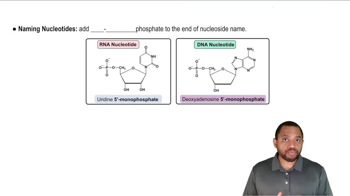
Nucleotides are the building blocks of nucleic acids, consisting of a sugar, a phosphate group, and a nitrogenous base. In DNA, the sugar is deoxyribose, while in RNA, it is ribose. The specific structure of nucleotides determines whether they are part of DNA or RNA, influencing their functions in genetic information storage and protein synthesis.
Recommended video:
Guided course
1:21
Naming Nucleosides and Nucleotides Concept 2

Deoxycytidine Monophosphate (dCMP)

Deoxycytidine monophosphate (dCMP) is a nucleotide that contains deoxyribose sugar, a phosphate group, and the nitrogenous base cytosine. It is specifically found in DNA, as indicated by the prefix 'deoxy,' which signifies the absence of an oxygen atom on the sugar compared to ribonucleotides found in RNA. Understanding the structure of dCMP is crucial for distinguishing between DNA and RNA components.
Recommended video:
Guided course
1:21
Naming Nucleosides and Nucleotides Concept 2

Differences Between DNA and RNA

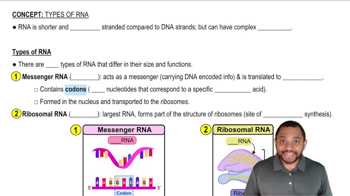
DNA and RNA are both nucleic acids but differ in several key aspects, including their sugar components, structure, and function. DNA is double-stranded and contains deoxyribose, while RNA is typically single-stranded and contains ribose. These differences are fundamental for their roles in genetic information storage (DNA) and protein synthesis (RNA), making it essential to recognize which components belong to each type.
Recommended video:
Guided course
2:43
Types of RNA Concept 1