Pearson+ LogoPearson+ Logo
Ch.14 Carboxylic Acids, Esters, Amines, and Amides
Timberlake - Chemistry: An Introduction to General, Organic, and Biological Chemistry 14th Edition
Timberlake14thChemistry: An Introduction to General, Organic, and Biological ChemistryISBN: 9781292472249Not the one you use?Change textbook
Chapter 14, Problem 81b

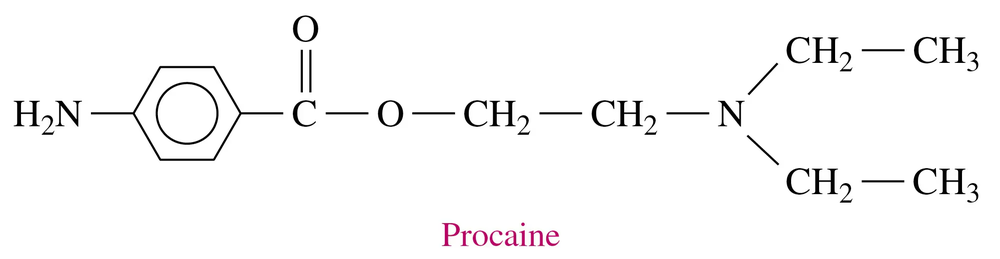
Novocain, a local anesthetic, is the ammonium salt of procaine.
Chemical structure of procaine, a local anesthetic, with labeled components including amine and ester groups.
b. Why is procaine hydrochloride used rather than procaine?

Verified step by step guidance
1
Understand the difference between procaine and procaine hydrochloride: Procaine is a weak base, while procaine hydrochloride is its ammonium salt, formed by reacting procaine with hydrochloric acid.
Recognize the solubility difference: Procaine hydrochloride is more water-soluble than procaine because the ammonium salt form is ionic, which allows it to dissolve more readily in aqueous solutions.
Consider the physiological environment: The human body contains a significant amount of water, so a water-soluble form like procaine hydrochloride is more effective for administration and absorption.
Account for stability: Procaine hydrochloride is more chemically stable than procaine in solution, which ensures that the anesthetic remains effective during storage and use.
Conclude the reasoning: Procaine hydrochloride is used instead of procaine because its increased solubility, stability, and compatibility with the body's aqueous environment make it a more practical and effective form for medical applications.

Verified video answer for a similar problem:

This video solution was recommended by our tutors as helpful for the problem above.
Video duration:
2m
Was this helpful?

Key Concepts

Here are the essential concepts you must grasp in order to answer the question correctly.

Local Anesthetics

Local anesthetics are medications used to induce a temporary loss of sensation in a specific area of the body. They work by blocking nerve signals in the targeted region, preventing the brain from receiving pain signals. Novocain, or procaine, is a classic example, commonly used in dental procedures to numb the area being treated.

Procaine vs. Procaine Hydrochloride

Procaine is the base form of the anesthetic, while procaine hydrochloride is its hydrochloride salt form. The hydrochloride salt is more soluble in water, which enhances its absorption and effectiveness when injected. This increased solubility allows for a more consistent and reliable anesthetic effect, making procaine hydrochloride the preferred choice in medical applications.
Recommended video:
Guided course
3:33
Enantiomers vs Diastereomers Concept 1

pH and Solubility

The pH of a solution can significantly affect the solubility and stability of drugs. Procaine hydrochloride, being a salt, is more stable and soluble in acidic environments, which is often the case in biological tissues. This property ensures that the anesthetic can be effectively delivered and utilized in the body, leading to better patient outcomes during procedures.
Recommended video:
Guided course
02:09
pH and pOH Calculations