Pearson+ LogoPearson+ Logo
Ch.13 Carbohydrates
Timberlake - Chemistry: An Introduction to General, Organic, and Biological Chemistry 14th Edition
Timberlake14thChemistry: An Introduction to General, Organic, and Biological ChemistryISBN: 9781292472249Not the one you use?Change textbook
Chapter 13, Problem 57b

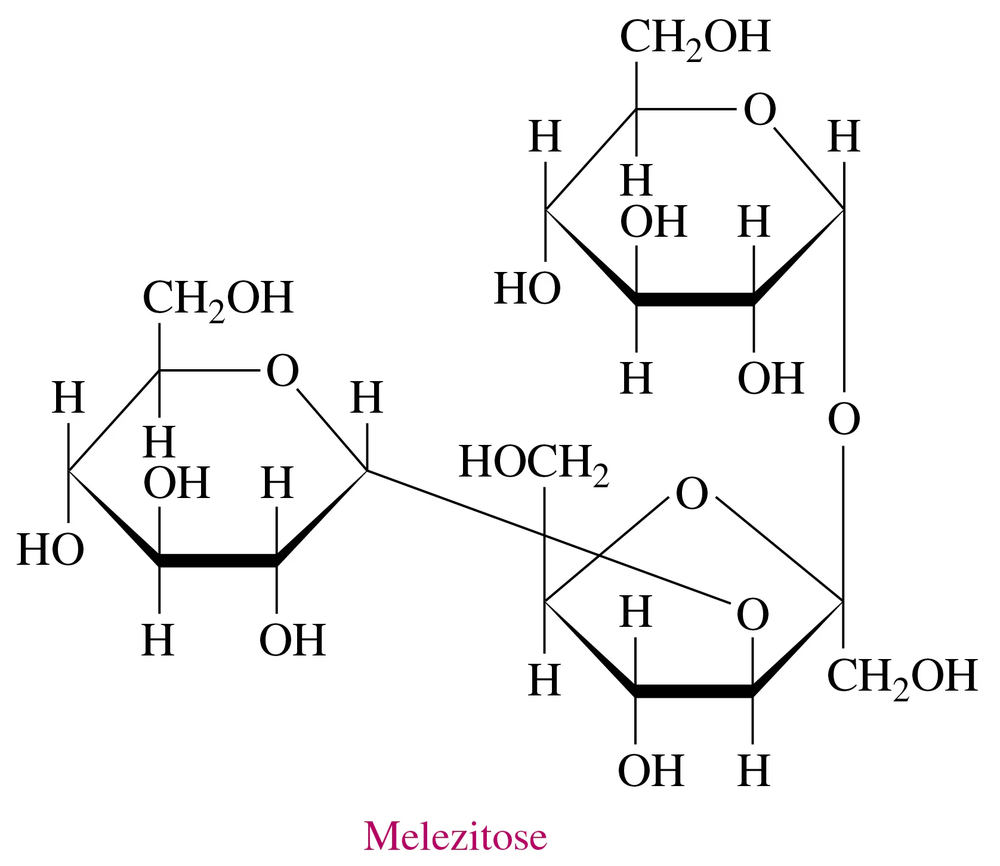
Melezitose, a carbohydrate secreted by insects, has the following Haworth structure:
Haworth structure of melezitose, a carbohydrate secreted by insects, with labeled hydroxyl groups and molecular formula.
b. What monosaccharides are present in melezitose?

Verified step by step guidance
1
Understand the problem: The question asks us to identify the monosaccharides present in melezitose based on its Haworth structure. A Haworth structure is a cyclic representation of a carbohydrate, showing the arrangement of atoms in a ring form.
Analyze the structure: Examine the given Haworth structure of melezitose. Look for the characteristic features of monosaccharides, such as the number of carbon atoms, the presence of hydroxyl (-OH) groups, and the type of glycosidic bonds connecting the monosaccharides.
Identify the monosaccharides: Melezitose is a trisaccharide, meaning it is composed of three monosaccharides. Based on the structure, determine the specific monosaccharides present. Common monosaccharides include glucose, fructose, and galactose, which can be identified by their unique structural features.
Check the glycosidic linkages: Observe how the monosaccharides are connected. The type of glycosidic bond (e.g., α-1,4 or β-1,2) can provide additional confirmation of the identity of the monosaccharides.
Summarize the findings: Once the monosaccharides are identified, list them along with any relevant details about their arrangement or bonding in melezitose.

Verified video answer for a similar problem:

This video solution was recommended by our tutors as helpful for the problem above.
Video duration:
2m
Was this helpful?

Key Concepts

Here are the essential concepts you must grasp in order to answer the question correctly.

Haworth Structure

The Haworth structure is a way of representing the cyclic form of carbohydrates, particularly sugars. It illustrates the arrangement of atoms in a sugar molecule, showing how the hydroxyl groups and other substituents are positioned around the ring. Understanding this structure is crucial for identifying the types of monosaccharides that make up disaccharides like melezitose.
Recommended video:
Guided course
2:18
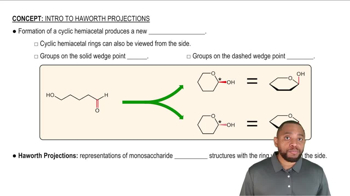
Intro to Haworth Projections Concept 1

Monosaccharides

Monosaccharides are the simplest form of carbohydrates, consisting of single sugar units. Common examples include glucose, fructose, and galactose. In the context of melezitose, recognizing the specific monosaccharides that combine to form this disaccharide is essential for understanding its chemical properties and biological functions.
Recommended video:
Guided course
0:55
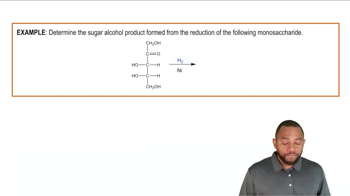
Reduction of Monosaccharides Example 1

Disaccharides

Disaccharides are carbohydrates formed by the condensation of two monosaccharides, linked by a glycosidic bond. Melezitose, specifically, is a disaccharide composed of two different monosaccharides. Identifying the monosaccharides in melezitose helps in understanding its structure, sweetness, and role in various biological processes.
Recommended video:
Guided course
3:39
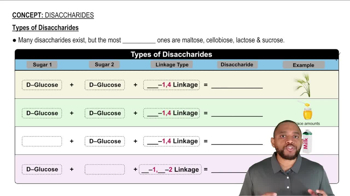
Types of Disaccharides Concept 1