Pearson+ LogoPearson+ Logo
Ch.13 Carbohydrates
Timberlake - Chemistry: An Introduction to General, Organic, and Biological Chemistry 14th Edition
Timberlake14thChemistry: An Introduction to General, Organic, and Biological ChemistryISBN: 9781292472249Not the one you use?Change textbook
Chapter 13, Problem 49a

Give the name of one or more polysaccharides that matches each of the following descriptions:
a. not digestible by humans

Verified step by step guidance
1
Step 1: Understand the term 'polysaccharide'. Polysaccharides are long chains of monosaccharide units linked by glycosidic bonds. They serve various functions such as energy storage (e.g., starch, glycogen) and structural support (e.g., cellulose, chitin).
Step 2: Recognize that the problem asks for a polysaccharide that is 'not digestible by humans'. This means the polysaccharide cannot be broken down by human digestive enzymes into its monosaccharide components.
Step 3: Recall that humans lack the enzyme cellulase, which is required to break the β(1→4) glycosidic bonds found in cellulose. Therefore, cellulose is a polysaccharide that is not digestible by humans.
Step 4: Consider other examples of indigestible polysaccharides. Chitin, another structural polysaccharide found in the exoskeletons of arthropods and fungal cell walls, is also not digestible by humans due to its β(1→4) glycosidic bonds and the presence of N-acetylglucosamine units.
Step 5: Conclude that cellulose and chitin are examples of polysaccharides that match the description of being 'not digestible by humans'.

Verified video answer for a similar problem:

This video solution was recommended by our tutors as helpful for the problem above.
Video duration:
1m
Was this helpful?

Key Concepts

Here are the essential concepts you must grasp in order to answer the question correctly.

Polysaccharides

Polysaccharides are complex carbohydrates composed of long chains of monosaccharide units. They serve various functions in living organisms, including energy storage and structural support. Common examples include starch, glycogen, and cellulose, each differing in their structure and digestibility.
Recommended video:
Guided course
1:24
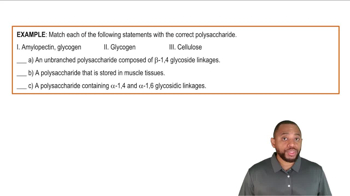
Polysaccharides Example 1

Digestibility

Digestibility refers to the extent to which a substance can be broken down and absorbed by the digestive system. In the context of polysaccharides, some, like starch, are digestible by humans, while others, such as cellulose, are not due to the lack of necessary enzymes to break them down.
Recommended video:
Guided course
2:01
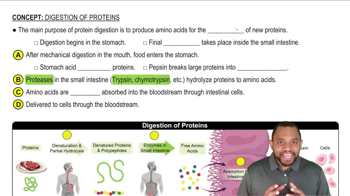
Digestion of Proteins Concept 1

Cellulose

Cellulose is a polysaccharide that forms the structural component of plant cell walls. It is composed of glucose units linked by β-1,4-glycosidic bonds, making it indigestible for humans. While it provides dietary fiber, aiding in digestion, it cannot be broken down into glucose for energy.