Pearson+ LogoPearson+ Logo
Ch.13 Carbohydrates
Timberlake - Chemistry: An Introduction to General, Organic, and Biological Chemistry 14th Edition
Timberlake14thChemistry: An Introduction to General, Organic, and Biological ChemistryISBN: 9781292472249Not the one you use?Change textbook
Chapter 13, Problem 70a

Use the Fischer projection for d-gulose in problem 13.69 to answer each of the following:
a. Draw the Fischer projection and name the product formed by the reduction of D-gulose.

Verified step by step guidance
1
Understand the problem: D-gulose is a monosaccharide, and the Fischer projection is a 2D representation of its structure. Reduction of a sugar typically involves converting the aldehyde group (-CHO) at the top of the Fischer projection into a primary alcohol (-CH2OH).
Draw the Fischer projection of D-gulose: Start by sketching the vertical carbon chain with the aldehyde group (-CHO) at the top. Place the hydroxyl (-OH) groups and hydrogen atoms on the appropriate sides of the chain based on the configuration of D-gulose. Ensure the bottom carbon has a -CH2OH group.
Apply the reduction reaction: Reduction of the aldehyde group (-CHO) at the top of the Fischer projection involves adding hydrogen (H2) in the presence of a reducing agent (e.g., NaBH4 or H2 with a catalyst). This converts the aldehyde group into a primary alcohol (-CH2OH).
Draw the Fischer projection of the reduced product: Replace the aldehyde group (-CHO) at the top of the D-gulose Fischer projection with a -CH2OH group. The rest of the structure remains unchanged.
Name the product: The reduction of D-gulose forms a sugar alcohol. Since D-gulose is a hexose, the resulting sugar alcohol is named D-gulitol (also known as D-sorbitol).

Verified video answer for a similar problem:

This video solution was recommended by our tutors as helpful for the problem above.
Video duration:
1m
Was this helpful?

Key Concepts

Here are the essential concepts you must grasp in order to answer the question correctly.

Fischer Projection

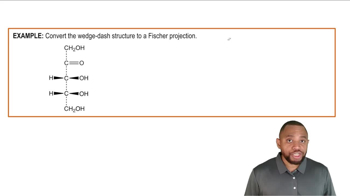
The Fischer projection is a two-dimensional representation of a molecule, particularly useful for depicting the stereochemistry of carbohydrates. In this format, the carbon chain is arranged vertically, with the most oxidized carbon at the top. Horizontal lines represent bonds that project out of the plane towards the viewer, while vertical lines indicate bonds that extend behind the plane. This method helps in visualizing the spatial arrangement of substituents around chiral centers.
Recommended video:
Guided course
0:48
Fischer Projections Example 1

Reduction of Sugars

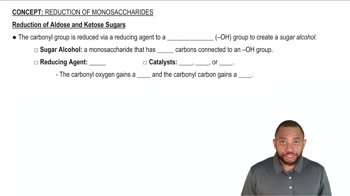
Reduction of sugars involves the conversion of a carbonyl group (aldehyde or ketone) into an alcohol group, typically through the action of reducing agents like sodium borohydride or lithium aluminum hydride. In the case of d-gulose, the reduction process transforms the aldehyde group at the first carbon into a primary alcohol, resulting in the formation of a sugar alcohol, specifically d-gulitol. This reaction is significant in carbohydrate chemistry as it alters the properties and reactivity of the sugar.
Recommended video:
Guided course
0:50
Reduction of Monosaccharides Concept 1

D- and L- Configuration

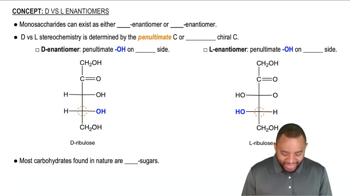
The D- and L- configuration refers to the stereochemical designation of sugars based on the orientation of the hydroxyl group on the penultimate carbon (the second-to-last carbon). In D-sugars, the hydroxyl group on this carbon is on the right in the Fischer projection, while in L-sugars, it is on the left. This classification is crucial for understanding the biological roles and interactions of carbohydrates, as D-forms are more prevalent in nature and are often the forms utilized by living organisms.
Recommended video:
Guided course
1:30
D vs L Enantiomers Concept 1