Pearson+ LogoPearson+ Logo
Ch.12 Alcohols, Thiols, Ethers, Aldehydes, and Ketones
Timberlake - Chemistry: An Introduction to General, Organic, and Biological Chemistry 14th Edition
Timberlake14thChemistry: An Introduction to General, Organic, and Biological ChemistryISBN: 9781292472249Not the one you use?Change textbook
Chapter 12, Problem 57d

Draw the condensed structural or line-angle formula, if cyclic, for each of the following:
d. 3-methylhexanal

Verified step by step guidance
1
Step 1: Understand the name '3-methylhexanal'. The suffix '-al' indicates that this compound is an aldehyde, meaning it contains a carbonyl group (C=O) at the end of the carbon chain. The parent chain is 'hexane', which means it has six carbon atoms in the longest continuous chain.
Step 2: Identify the substituent. The prefix '3-methyl' indicates that there is a methyl group (-CH₃) attached to the third carbon atom of the hexane chain.
Step 3: Place the aldehyde group. Since aldehydes always have the carbonyl group at the end of the chain, the carbonyl group will be on the first carbon atom of the hexane chain.
Step 4: Draw the structure. Start with a six-carbon chain (hexane), add the aldehyde group (C=O) to the first carbon, and attach a methyl group (-CH₃) to the third carbon. Ensure all other carbons are fully saturated with hydrogen atoms.
Step 5: Represent the structure in the requested format. For the condensed structural formula, write it as CH₃-CH(CH₃)-CH₂-CH₂-CH₂-CHO. For the line-angle formula, draw a zigzag line with six vertices (representing the six carbons), place a double bond to oxygen at the first vertex, and add a branch at the third vertex to represent the methyl group.

Verified video answer for a similar problem:

This video solution was recommended by our tutors as helpful for the problem above.
Was this helpful?

Key Concepts

Here are the essential concepts you must grasp in order to answer the question correctly.

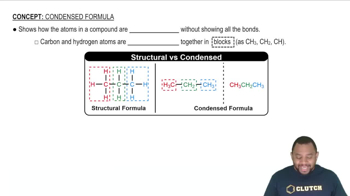
Condensed Structural Formula

A condensed structural formula is a way of representing a chemical compound that shows the arrangement of atoms and the connectivity between them without depicting all the bonds explicitly. It typically groups atoms together to indicate how they are connected, making it easier to visualize the structure of organic molecules. For example, in 3-methylhexanal, the condensed formula would highlight the hexane backbone with a methyl group attached at the third carbon.
Recommended video:
Guided course
1:53
Condensed Formula Concept 1

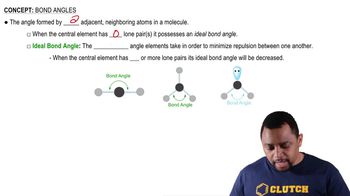
Line-Angle Formula

The line-angle formula, also known as the skeletal formula, is a simplified way of drawing organic molecules where vertices represent carbon atoms and lines represent bonds. This method omits hydrogen atoms attached to carbons, making it easier to visualize larger structures. In the case of 3-methylhexanal, the line-angle formula would illustrate the hexane chain with a branch indicating the methyl group at the specified position.
Recommended video:
Guided course
01:24
Bond Angles (Simplified) Concept 1

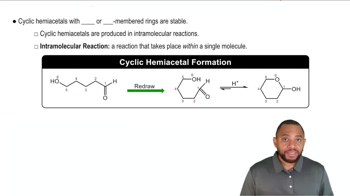
Cyclic Compounds

Cyclic compounds are organic molecules that contain a ring structure, where the carbon atoms are connected in a loop. This can affect the chemical properties and reactivity of the compound compared to its linear counterparts. While 3-methylhexanal is not a cyclic compound, understanding cyclic structures is essential for recognizing how different arrangements can influence molecular behavior in organic chemistry.
Recommended video:
Guided course
2:55
Cyclic Hemiacetals Concept 2