Pearson+ LogoPearson+ Logo
Ch.12 Alcohols, Thiols, Ethers, Aldehydes, and Ketones
Timberlake - Chemistry: An Introduction to General, Organic, and Biological Chemistry 14th Edition
Timberlake14thChemistry: An Introduction to General, Organic, and Biological ChemistryISBN: 9781292472249Not the one you use?Change textbook
Chapter 12, Problem 53b

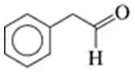
Draw the condensed structural or line-angle formula for the alcohol produced when hydrogen and a nickel catalyst reduce each of the following:
b.

Verified step by step guidance
1
Identify the functional group in the given compound. In this case, the compound likely contains a carbonyl group (C=O), as alcohols are typically produced by the reduction of aldehydes or ketones.
Understand the reduction process: When a carbonyl group is reduced using hydrogen (H₂) and a nickel catalyst, the double bond between carbon and oxygen is broken, and two hydrogen atoms are added. This converts the carbonyl group into a hydroxyl group (-OH), forming an alcohol.
Determine the type of alcohol formed: If the carbonyl group is part of an aldehyde, the reduction will produce a primary alcohol. If the carbonyl group is part of a ketone, the reduction will produce a secondary alcohol.
Draw the structure of the alcohol: Replace the carbonyl group (C=O) in the original structure with a hydroxyl group (-OH) and ensure that the remaining bonds and substituents are correctly represented in the condensed structural or line-angle formula.
Verify the final structure: Check that the resulting alcohol structure is consistent with the original compound and the reduction process, ensuring all atoms have the correct number of bonds and the structure adheres to standard chemical notation.

Verified video answer for a similar problem:

This video solution was recommended by our tutors as helpful for the problem above.
Was this helpful?

Key Concepts

Here are the essential concepts you must grasp in order to answer the question correctly.

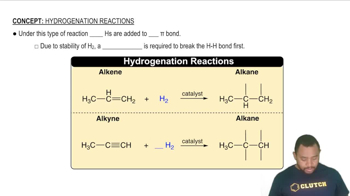
Hydrogenation

Hydrogenation is a chemical reaction that involves the addition of hydrogen (H2) to a compound, typically in the presence of a catalyst such as nickel. This process is commonly used to convert unsaturated organic compounds, like alkenes or alkynes, into saturated compounds, such as alkanes or alcohols. Understanding hydrogenation is crucial for predicting the products of the reaction described in the question.
Recommended video:
Guided course
1:22
Hydrogenation Reactions Concept 1

Alcohol Functional Group

An alcohol is an organic compound that contains one or more hydroxyl (-OH) functional groups attached to a carbon atom. The presence of this functional group is what classifies a compound as an alcohol, influencing its chemical properties and reactivity. Recognizing the structure of alcohols is essential for drawing their condensed structural or line-angle formulas.
Recommended video:
Guided course
1:41
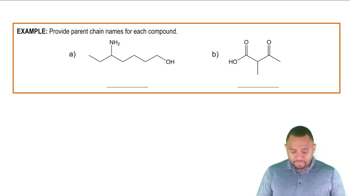
Functional Group Priorities Example 1

Condensed Structural and Line-Angle Formulas

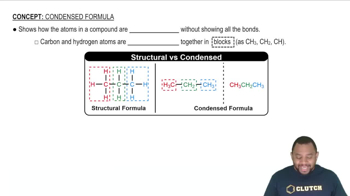
Condensed structural formulas provide a simplified representation of a molecule, showing the arrangement of atoms and functional groups without depicting all bonds explicitly. Line-angle formulas, on the other hand, use lines to represent bonds between atoms, with vertices representing carbon atoms. Mastery of these formulas is important for accurately illustrating the structure of the alcohol produced from the hydrogenation reaction.
Recommended video:
Guided course
1:53
Condensed Formula Concept 1