Pearson+ LogoPearson+ Logo
Ch.11 Introduction to Organic Chemistry: Hydrocarbons
Timberlake - Chemistry: An Introduction to General, Organic, and Biological Chemistry 14th Edition
Timberlake14thChemistry: An Introduction to General, Organic, and Biological ChemistryISBN: 9781292472249Not the one you use?Change textbook
Chapter 11, Problem 1f

Identify each of the following as a formula of an organic or inorganic compound. For an organic compound, indicate if represented as molecular formula, expanded, or condensed structural formula:
f. C3H7Cl

Verified step by step guidance
1
Step 1: Understand the distinction between organic and inorganic compounds. Organic compounds primarily contain carbon (C) and hydrogen (H), often with other elements like oxygen (O), nitrogen (N), or halogens (e.g., Cl). Inorganic compounds typically do not have carbon-hydrogen bonds.
Step 2: Analyze the given formula, C₃H₇Cl. It contains carbon (C), hydrogen (H), and chlorine (Cl). The presence of carbon and hydrogen suggests it is an organic compound.
Step 3: Determine the type of formula representation. A molecular formula provides the exact number of each type of atom in the compound but does not show how the atoms are connected. C₃H₇Cl is a molecular formula because it lists the number of carbon, hydrogen, and chlorine atoms without showing their arrangement.
Step 4: Recall that expanded structural formulas show all bonds between atoms, while condensed structural formulas group atoms together to indicate connectivity in a more compact form. Since C₃H₇Cl does not show bonds or connectivity, it is not an expanded or condensed structural formula.
Step 5: Conclude that C₃H₇Cl is an organic compound represented as a molecular formula.

Verified video answer for a similar problem:

This video solution was recommended by our tutors as helpful for the problem above.
Was this helpful?

Key Concepts

Here are the essential concepts you must grasp in order to answer the question correctly.

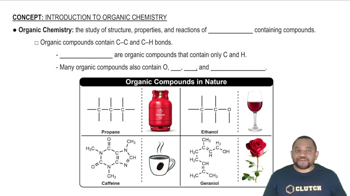
Organic vs. Inorganic Compounds

Organic compounds primarily consist of carbon atoms and often include hydrogen, oxygen, nitrogen, and other elements. They are typically associated with living organisms and include substances like hydrocarbons and their derivatives. In contrast, inorganic compounds generally do not contain carbon-hydrogen bonds and include minerals, metals, and salts.
Recommended video:
Guided course
2:26
Introduction to Organic Chemistry Concept 1

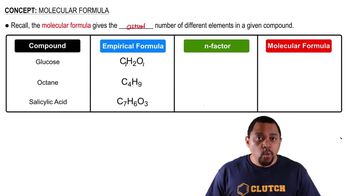
Molecular Formula

A molecular formula represents the number and types of atoms in a molecule without indicating the arrangement of those atoms. For example, C₃H₇Cl indicates that the compound contains three carbon atoms, seven hydrogen atoms, and one chlorine atom. This formula provides essential information about the composition of the compound but not its structure.
Recommended video:
Guided course
02:08
Molecular Formula

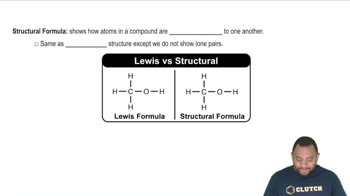
Structural Formulas

Structural formulas provide a visual representation of the arrangement of atoms within a molecule. They can be expanded, showing all bonds and atoms explicitly, or condensed, summarizing the structure in a more compact form. Understanding structural formulas is crucial for analyzing the reactivity and properties of organic compounds, as the arrangement of atoms significantly influences their behavior.
Recommended video:
Guided course
1:01
Structural Formula Concept 2