Pearson+ LogoPearson+ Logo
Ch.11 Introduction to Organic Chemistry: Hydrocarbons
Timberlake - Chemistry: An Introduction to General, Organic, and Biological Chemistry 14th Edition
Timberlake14thChemistry: An Introduction to General, Organic, and Biological ChemistryISBN: 9781292472249Not the one you use?Change textbook
Chapter 11, Problem 64c

Give the name for the product from the hydrogenation of each of the following:
c. cyclopropene

Verified step by step guidance
1
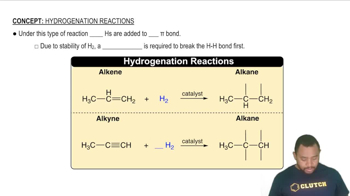
Identify the type of reaction: Hydrogenation is a chemical reaction where hydrogen (H₂) is added to a molecule, typically across a double or triple bond, converting unsaturated compounds into saturated ones.
Examine the structure of cyclopropene: Cyclopropene is a three-membered ring with one double bond. The double bond makes it an unsaturated compound.
Understand the effect of hydrogenation: During hydrogenation, the double bond in cyclopropene will be broken, and two hydrogen atoms will be added to the molecule, resulting in a saturated compound.
Determine the product: Breaking the double bond in cyclopropene and adding hydrogen atoms will convert it into cyclopropane, which is a saturated three-membered ring with only single bonds.
Name the product: The name of the product formed after hydrogenation of cyclopropene is cyclopropane.

Verified video answer for a similar problem:

This video solution was recommended by our tutors as helpful for the problem above.
Was this helpful?

Key Concepts

Here are the essential concepts you must grasp in order to answer the question correctly.

Hydrogenation

Hydrogenation is a chemical reaction that involves the addition of hydrogen (H2) to an unsaturated compound, typically an alkene or alkyne, to convert it into a saturated compound. This process is commonly used in organic chemistry to increase the stability of compounds by reducing the number of double or triple bonds. In the case of cyclopropene, hydrogenation will result in the formation of cyclopropane.
Recommended video:
Guided course
1:22
Hydrogenation Reactions Concept 1

Cyclopropene

Cyclopropene is a three-membered cyclic alkene characterized by a double bond between two of its carbon atoms. It is known for its ring strain due to the small size of the ring and the presence of the double bond, making it more reactive than larger cyclic alkenes. Understanding its structure is crucial for predicting the products of its hydrogenation.

Saturated vs. Unsaturated Compounds

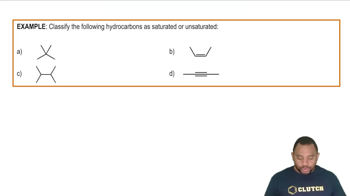
Saturated compounds contain only single bonds between carbon atoms, while unsaturated compounds contain one or more double or triple bonds. The hydrogenation process transforms unsaturated compounds into saturated ones by adding hydrogen atoms, thus increasing their stability and altering their chemical properties. Recognizing the difference between these types of compounds is essential for predicting the outcome of reactions like hydrogenation.
Recommended video:
Guided course
0:57
Saturated and Unsaturated Hydrocarbons Example 2