Pearson+ LogoPearson+ Logo
Ch.8 Gases
Timberlake - Chemistry: An Introduction to General, Organic, and Biological Chemistry 13th Edition
Timberlake13th EditionChemistry: An Introduction to General, Organic, and Biological ChemistryISBN: 9780134421353Not the one you use?Change textbook
Chapter 8, Problem 66d

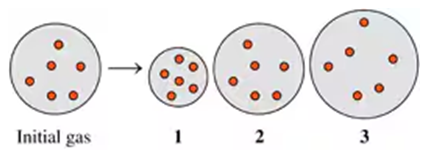
Indicate which diagram (1, 2, or 3) represents the volume of the gas sample in a flexible container when each of the following changes (a to d) takes place:

d. Doubling the atmospheric pressure and doubling the Kelvin temperature.

Verified step by step guidance
1
Step 1: Recall the combined gas law, which relates pressure (P), volume (V), and temperature (T) for a gas sample: \( \frac{P_1 V_1}{T_1} = \frac{P_2 V_2}{T_2} \). This equation will help us analyze the changes in pressure and temperature and their effect on volume.
Step 2: Identify the changes in the problem. The atmospheric pressure is doubled (\( P_2 = 2P_1 \)) and the Kelvin temperature is also doubled (\( T_2 = 2T_1 \)). Substitute these changes into the combined gas law equation.
Step 3: Simplify the equation to determine the relationship between the initial and final volumes. Substituting \( P_2 = 2P_1 \) and \( T_2 = 2T_1 \) into \( \frac{P_1 V_1}{T_1} = \frac{P_2 V_2}{T_2} \), we get \( \frac{P_1 V_1}{T_1} = \frac{2P_1 V_2}{2T_1} \). Cancel out common terms to simplify further.
Step 4: After simplification, the equation becomes \( V_1 = V_2 \). This indicates that the volume of the gas remains unchanged when both pressure and temperature are doubled.
Step 5: Analyze the diagrams provided. Since the volume remains constant, the diagram that represents the same number of gas particles in the same container size as the initial state corresponds to the correct answer. Compare the diagrams to identify which one matches this condition.

Verified video answer for a similar problem:

This video solution was recommended by our tutors as helpful for the problem above.
Video duration:
1m
Was this helpful?

Key Concepts

Here are the essential concepts you must grasp in order to answer the question correctly.

Gas Laws

Gas laws describe the behavior of gases under various conditions of pressure, volume, and temperature. Key laws include Boyle's Law, which states that pressure and volume are inversely related at constant temperature, and Charles's Law, which states that volume is directly proportional to temperature at constant pressure. Understanding these laws is essential for predicting how gas volume changes with alterations in pressure and temperature.
Recommended video:
Guided course
01:43
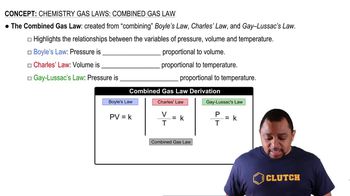
Chemistry Gas Laws: Combined Gas Law

Ideal Gas Behavior

The ideal gas law combines several gas laws into a single equation (PV=nRT) that relates pressure (P), volume (V), temperature (T), and the number of moles (n) of a gas. While real gases deviate from ideal behavior under high pressure or low temperature, the ideal gas law provides a useful approximation for many conditions. Recognizing when to apply this law is crucial for solving problems involving gas behavior.
Recommended video:
Guided course
01:15
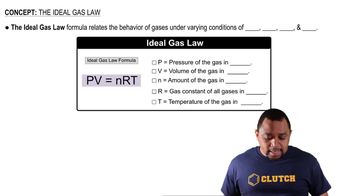
The Ideal Gas Law Concept 1

Flexible Container Dynamics

A flexible container, such as a balloon, allows gas to expand or contract in response to changes in pressure and temperature. When atmospheric pressure increases, the volume of gas typically decreases unless compensated by an increase in temperature. Understanding how these dynamics interact helps in visualizing the changes in gas volume represented in the diagrams, particularly when both pressure and temperature are altered simultaneously.
Recommended video:
Guided course
01:34
Periodic Table: Transition Metals Charges Example 1