Pearson+ LogoPearson+ Logo
Ch.13 Carbohydrates
Timberlake - Chemistry: An Introduction to General, Organic, and Biological Chemistry 13th Edition
Timberlake13th EditionChemistry: An Introduction to General, Organic, and Biological ChemistryISBN: 9780134421353Not the one you use?Change textbook
Chapter 13, Problem 55d

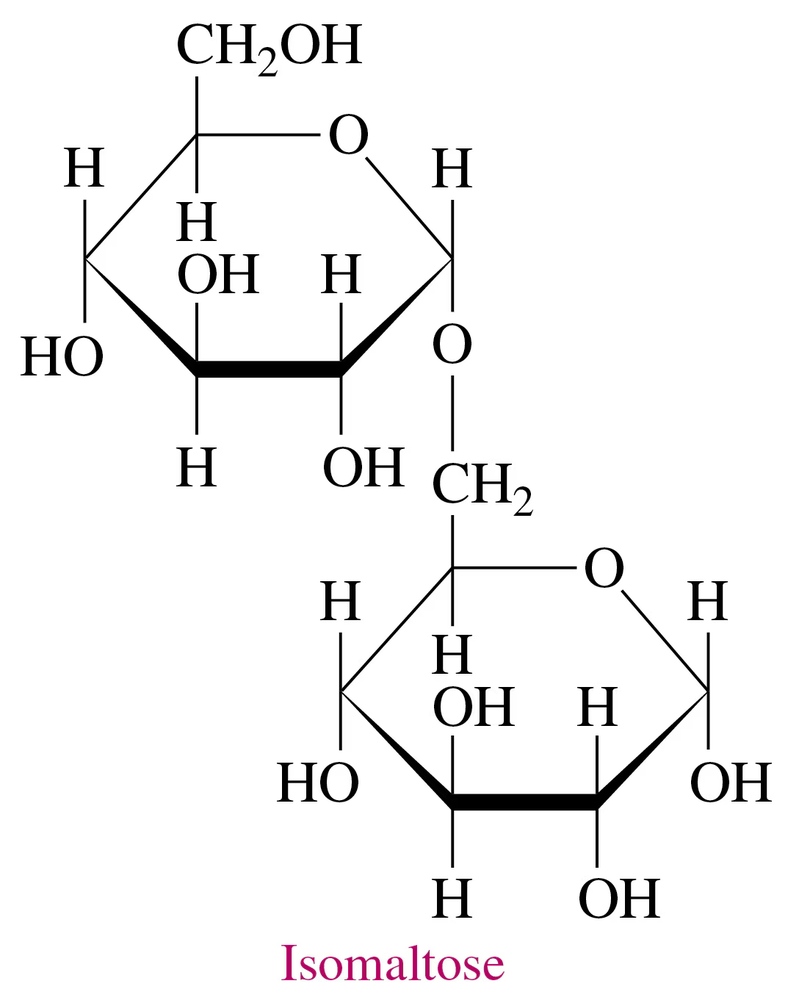
Isomaltose, obtained from the breakdown of starch, has the following Haworth structure:
Haworth structure of isomaltose, a disaccharide formed from starch breakdown, labeled below the diagram.
d. Is this the α or β isomer of isomaltose? 

Verified step by step guidance
1
Examine the Haworth structure of isomaltose provided in the problem. Focus on the orientation of the hydroxyl group (-OH) attached to the anomeric carbon (the carbon directly bonded to two oxygen atoms in the ring).
Identify the anomeric carbon in the first glucose unit of isomaltose. This is the carbon that was part of the carbonyl group in the linear form of glucose before cyclization.
Determine the position of the hydroxyl group (-OH) on the anomeric carbon. If the -OH group is pointing downward (trans to the CH2OH group), it is the α-isomer. If the -OH group is pointing upward (cis to the CH2OH group), it is the β-isomer.
Compare the orientation of the -OH group on the anomeric carbon to the CH2OH group on the same glucose unit. This will help confirm whether the structure is α or β.
Conclude whether the given structure represents the α or β isomer of isomaltose based on the orientation of the hydroxyl group on the anomeric carbon.

Verified video answer for a similar problem:

This video solution was recommended by our tutors as helpful for the problem above.
Video duration:
2m
Was this helpful?

Key Concepts

Here are the essential concepts you must grasp in order to answer the question correctly.

Haworth Structure

The Haworth structure is a way of representing the cyclic form of monosaccharides and disaccharides, showing the arrangement of atoms in a ring. It illustrates the anomeric carbon, which is crucial for determining the alpha or beta configuration of sugars. In the case of isomaltose, understanding its Haworth structure helps identify the orientation of the hydroxyl group at the anomeric carbon.
Recommended video:
Guided course
2:18
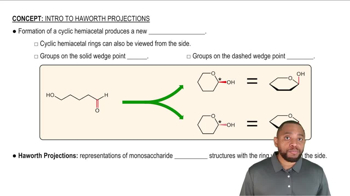
Intro to Haworth Projections Concept 1

Alpha and Beta Anomers

Alpha and beta anomers refer to the two possible configurations of a sugar at its anomeric carbon, which is the carbon derived from the carbonyl group during cyclization. In the alpha form, the hydroxyl group on the anomeric carbon is positioned on the opposite side of the ring from the CH2OH group, while in the beta form, it is on the same side. This distinction is essential for understanding the properties and reactivity of carbohydrates.
Recommended video:
Guided course
01:02
Characteristics of Beta Particles Example

Isomaltose

Isomaltose is a disaccharide composed of two glucose units linked by an α(1→6) glycosidic bond, formed during the enzymatic breakdown of starch. Its structure and configuration influence its digestibility and sweetness compared to other sugars. Recognizing whether isomaltose is in its alpha or beta form is important for its biochemical behavior and applications in food science.