Pearson+ LogoPearson+ Logo
Ch.13 Carbohydrates
Timberlake - Chemistry: An Introduction to General, Organic, and Biological Chemistry 13th Edition
Timberlake13th EditionChemistry: An Introduction to General, Organic, and Biological ChemistryISBN: 9780134421353Not the one you use?Change textbook
Chapter 13, Problem 50d

Give the name of one or more polysaccharides that matches each of the following descriptions:
d. produces maltose during digestion

Verified step by step guidance
1
Understand the problem: The question asks for a polysaccharide that, when digested, produces maltose. Maltose is a disaccharide composed of two glucose units linked by an α(1→4) glycosidic bond.
Recall the structure of polysaccharides: Polysaccharides are long chains of monosaccharides (like glucose) linked by glycosidic bonds. Some polysaccharides can be broken down into smaller units, such as disaccharides, during digestion.
Identify the polysaccharide that produces maltose: Starch is a polysaccharide made of glucose units linked by α(1→4) glycosidic bonds. During digestion, enzymes like amylase break down starch into maltose.
Consider the components of starch: Starch consists of two components—amylose (a linear polymer of glucose) and amylopectin (a branched polymer of glucose). Both components can produce maltose during digestion.
Conclude the answer: The polysaccharide that produces maltose during digestion is starch, which includes amylose and amylopectin as its components.

Verified video answer for a similar problem:

This video solution was recommended by our tutors as helpful for the problem above.
Video duration:
2m
Was this helpful?

Key Concepts

Here are the essential concepts you must grasp in order to answer the question correctly.

Polysaccharides

Polysaccharides are long chains of monosaccharide units linked by glycosidic bonds. They serve various functions in living organisms, including energy storage and structural support. Common examples include starch, glycogen, and cellulose. Understanding their structure and function is essential for identifying specific polysaccharides based on their digestion products.
Recommended video:
Guided course
1:24
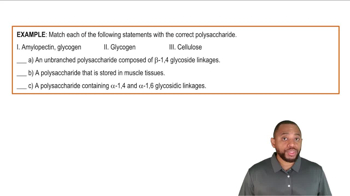
Polysaccharides Example 1

Maltose

Maltose is a disaccharide composed of two glucose molecules linked by an α(1→4) glycosidic bond. It is produced during the digestion of starch and glycogen by the enzyme amylase. Recognizing maltose's formation is crucial for linking polysaccharides to their digestive processes, particularly in carbohydrate metabolism.
Recommended video:
Guided course
0:50
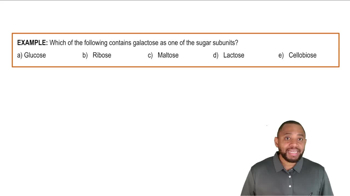
Types of Disaccharides Example 1

Amylase

Amylase is an enzyme that catalyzes the hydrolysis of starch into sugars, primarily maltose. It is found in saliva and the pancreas, playing a vital role in carbohydrate digestion. Understanding the function of amylase helps in identifying which polysaccharides yield maltose during digestion, as it breaks down complex carbohydrates into simpler sugars.
Recommended video:
Guided course
0:50
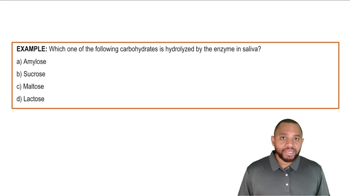
Intro To Carbohydrate Metabolism Example 1