Pearson+ LogoPearson+ Logo
Ch.12 Alcohols, Thiols, Ethers, Aldehydes, and Ketones
Timberlake - Chemistry: An Introduction to General, Organic, and Biological Chemistry 13th Edition
Timberlake13th EditionChemistry: An Introduction to General, Organic, and Biological ChemistryISBN: 9780134421353Not the one you use?Change textbook
Chapter 12, Problem 28b

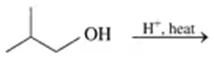
Draw the condensed structural or line-angle formula for the alkene produced by each of the following dehydration reactions:
b.

Verified step by step guidance
1
Identify the alcohol functional group in the given molecule. The dehydration reaction involves the removal of a water molecule (H₂O) from the alcohol group.
Determine the hydrogen atom that will be removed from a neighboring carbon atom. This is based on the Zaitsev's rule, which states that the more substituted alkene (the one with more alkyl groups attached to the double-bonded carbons) is the major product.
Remove the hydroxyl group (-OH) from the alcohol carbon and a hydrogen atom from the adjacent carbon to form a double bond between these two carbons.
Draw the condensed structural formula or line-angle formula of the resulting alkene. Ensure that the double bond is correctly placed and that the structure adheres to the rules of organic chemistry.
Verify the structure to ensure it represents the major product of the dehydration reaction, considering the stability of the alkene formed (more substituted alkenes are generally more stable).

Verified video answer for a similar problem:

This video solution was recommended by our tutors as helpful for the problem above.
Was this helpful?

Key Concepts

Here are the essential concepts you must grasp in order to answer the question correctly.

Dehydration Reaction

A dehydration reaction is a chemical process in which a water molecule is removed from a compound. In organic chemistry, this often involves the conversion of alcohols into alkenes by eliminating a hydroxyl group and a hydrogen atom. Understanding this reaction is crucial for predicting the structure of the resulting alkene.
Recommended video:
Guided course
1:30
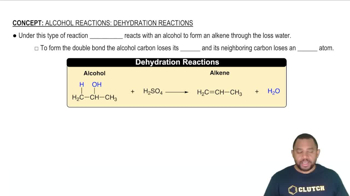
Alcohol Reactions: Dehydration Reactions Concept 1

Alkene Structure

Alkenes are hydrocarbons that contain at least one carbon-carbon double bond (C=C). Their general formula is CnH2n, where n is the number of carbon atoms. The presence of the double bond affects the physical and chemical properties of the compound, making it important to accurately represent the alkene's structure in condensed or line-angle formulas.
Recommended video:
Guided course
3:26
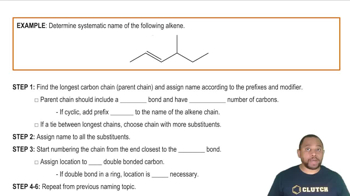
Naming Alkenes Example 1

Condensed Structural Formula

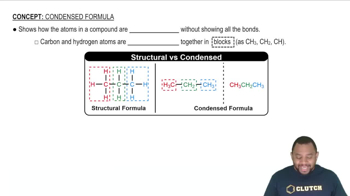
A condensed structural formula is a way of representing a chemical structure that shows the arrangement of atoms in a molecule without depicting all the bonds explicitly. It provides a simplified view of the molecule, indicating how atoms are grouped together. This format is particularly useful for visualizing the structure of organic compounds like alkenes in a compact manner.
Recommended video:
Guided course
1:53
Condensed Formula Concept 1