Pearson+ LogoPearson+ Logo
Ch.11 Nucleic Acids Big Molecules with a Big Role
Frost - General, Organic and Biological Chemistry 4th Edition
Frost4th EditionGeneral, Organic and Biological ChemistryISBN: 9780134988696Not the one you use?Change textbook
Chapter 7, Problem 41c

For each of the following, note whether the component can be found in a virus, a cell, or both.
c. capsid

Verified step by step guidance
1
Understand the term 'capsid': A capsid is the protein shell that encloses the genetic material of a virus. It provides protection and aids in the delivery of the viral genome into host cells.
Recall the structural differences between viruses and cells: Viruses are acellular entities that rely on a host cell for replication, whereas cells are the basic structural and functional units of life.
Determine whether a capsid is present in viruses: Capsids are a defining feature of viruses, as they are essential for their structure and function.
Evaluate whether a capsid is found in cells: Cells do not have capsids because they do not require a protein shell to protect their genetic material; instead, their genetic material is enclosed within a nucleus (eukaryotic cells) or nucleoid region (prokaryotic cells).
Conclude that capsids are exclusive to viruses and cannot be found in cells.

Verified video answer for a similar problem:

This video solution was recommended by our tutors as helpful for the problem above.
Video duration:
1m
Was this helpful?

Key Concepts

Here are the essential concepts you must grasp in order to answer the question correctly.

Capsid

A capsid is the protein shell of a virus that encases its genetic material. It plays a crucial role in protecting the viral genome and facilitating the delivery of the virus into host cells. Unlike cellular structures, capsids are unique to viruses and are essential for their infectivity.

Viruses vs. Cells

Viruses are acellular entities that require a host cell to replicate, while cells are the basic structural and functional units of living organisms. Cells contain organelles and can carry out metabolic processes independently, whereas viruses lack cellular machinery and cannot reproduce on their own.
Recommended video:
Guided course
0:50
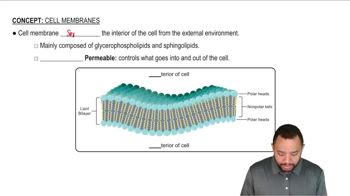
Cell Membranes Concept 1

Viral Structure

The structure of a virus typically includes a nucleic acid core (DNA or RNA) surrounded by a capsid, and sometimes an outer lipid envelope. This structure is critical for the virus's ability to infect host cells and is distinct from cellular structures, which include membranes, cytoplasm, and organelles.
Recommended video:
Guided course
1:01
Structural Formula Concept 2