Pearson+ LogoPearson+ Logo
Ch.11 Nucleic Acids Big Molecules with a Big Role
Frost - General, Organic and Biological Chemistry 4th Edition
Frost4th EditionGeneral, Organic and Biological ChemistryISBN: 9780134988696Not the one you use?Change textbook
Chapter 7, Problem 40c

Consider the following portion of mRNA produced by the normal order of DNA nucleotides:
5'ACA|UCA|CGG|GUA3'
c. Write the amino acid sequence if a mutation changes CGG to GGG. Is this likely to affect protein function?

Verified step by step guidance
1
Step 1: Understand the problem. The mRNA sequence provided is 5'ACA|UCA|CGG|GUA3'. A mutation changes CGG to GGG. The task is to determine the amino acid sequence before and after the mutation and assess whether this change is likely to affect protein function.
Step 2: Recall the process of translation. Each codon (group of three nucleotides) in mRNA corresponds to a specific amino acid. Use the genetic code table to identify the amino acids for each codon in the sequence.
Step 3: Translate the original mRNA sequence. Identify the amino acids corresponding to the codons ACA, UCA, CGG, and GUA using the genetic code table. Write down the amino acid sequence.
Step 4: Translate the mutated mRNA sequence. Replace CGG with GGG in the sequence and identify the amino acids corresponding to ACA, UCA, GGG, and GUA using the genetic code table. Write down the new amino acid sequence.
Step 5: Compare the original and mutated amino acid sequences. Determine if the mutation results in a change in the amino acid. If the amino acid changes, assess whether this change is likely to affect protein function based on the properties of the amino acids involved (e.g., polarity, size, charge).

Verified video answer for a similar problem:

This video solution was recommended by our tutors as helpful for the problem above.
Video duration:
5m
Was this helpful?

Key Concepts

Here are the essential concepts you must grasp in order to answer the question correctly.

mRNA Translation

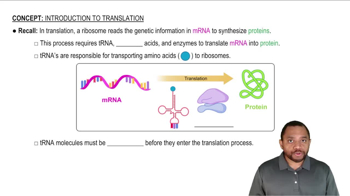
mRNA translation is the process by which ribosomes synthesize proteins based on the sequence of nucleotides in mRNA. Each set of three nucleotides, known as a codon, corresponds to a specific amino acid. Understanding this process is crucial for determining how changes in the mRNA sequence can affect the resulting protein.
Recommended video:
Guided course
1:42
Introduction to Translation Concept 1

Amino Acid Codons

Amino acid codons are triplet sequences of nucleotides in mRNA that specify which amino acids will be added during protein synthesis. For example, the codon CGG codes for the amino acid arginine, while GGG codes for glycine. Recognizing the relationship between codons and their corresponding amino acids is essential for analyzing mutations and their potential impacts on protein structure.
Recommended video:
Guided course
3:03
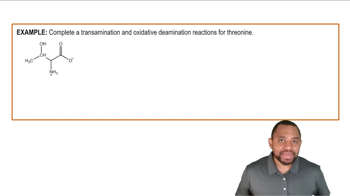
Amino Acid Catabolism: Amino Group Example 2

Mutation Impact on Protein Function

Mutations are changes in the nucleotide sequence of DNA or RNA that can alter the amino acid sequence of proteins. The effect of a mutation on protein function depends on the nature of the change; for instance, a mutation that results in a different amino acid may affect the protein's structure and function. Evaluating whether a specific mutation, like CGG to GGG, impacts protein function requires understanding the role of the affected amino acid in the protein's overall activity.
Recommended video:
Guided course
02:16
Logarithmic Functions