
Pearson+ LogoPearson+ Logo
Ch.11 Nucleic Acids Big Molecules with a Big Role
Frost - General, Organic and Biological Chemistry 4th Edition
Frost4th EditionGeneral, Organic and Biological ChemistryISBN: 9780134988696Not the one you use?Change textbook
Chapter 7, Problem 42a

For each of the following, note whether the component can be found in a virus, a cell, or both.
a. RNA

Verified step by step guidance
1
Understand the structure and composition of viruses and cells. Viruses are simpler entities that rely on host cells for replication, while cells are complex structures capable of independent life processes.
Recall that RNA (ribonucleic acid) is a nucleic acid that plays a crucial role in coding, decoding, regulation, and expression of genes. It can serve as genetic material or be involved in protein synthesis.
Note that viruses can contain RNA as their genetic material instead of DNA. RNA viruses use RNA to store and transmit genetic information.
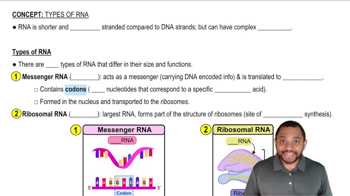
Recognize that cells also contain RNA, which is essential for processes like transcription and translation in protein synthesis. RNA is found in various forms, such as mRNA, tRNA, and rRNA, within cells.
Conclude that RNA can be found in both viruses and cells, as it serves distinct roles in each entity's biological processes.

Verified video answer for a similar problem:

This video solution was recommended by our tutors as helpful for the problem above.
Video duration:
1m
Was this helpful?

Key Concepts

Here are the essential concepts you must grasp in order to answer the question correctly.

RNA

Ribonucleic acid (RNA) is a crucial molecule involved in various biological roles, including coding, decoding, regulation, and expression of genes. In viruses, RNA can serve as the genetic material, either as single-stranded or double-stranded RNA. In cells, RNA is synthesized from DNA and plays a key role in protein synthesis through messenger RNA (mRNA), transfer RNA (tRNA), and ribosomal RNA (rRNA).
Recommended video:
Guided course
2:43
Types of RNA Concept 1

Viruses

Viruses are microscopic infectious agents that require a host cell to replicate and propagate. They consist of genetic material (either DNA or RNA) encased in a protein coat, and they lack cellular structures and metabolic processes. Viruses can infect various organisms, including animals, plants, and bacteria, and they can only reproduce by hijacking the cellular machinery of their host.

Cells

Cells are the basic structural and functional units of all living organisms. They can be prokaryotic (like bacteria) or eukaryotic (like plant and animal cells), and they contain various organelles that perform specific functions. Cells have their own genetic material (DNA) and can replicate independently, unlike viruses, which depend on host cells for reproduction.
Recommended video:
Guided course
0:50
Cell Membranes Concept 1