Pearson+ LogoPearson+ Logo
Ch.10 Proteins Workers of the Cell
Frost - General, Organic and Biological Chemistry 4th Edition
Frost4th EditionGeneral, Organic and Biological ChemistryISBN: 9780134988696Not the one you use?Change textbook
Chapter 6, Problem 54e

Indicate whether each of the following describes a competitive or a noncompetitive inhibitor.
e. Adding more substrate to the reaction restores the enzyme activity.

Verified step by step guidance
1
Understand the two types of enzyme inhibitors: Competitive inhibitors bind to the active site of the enzyme, competing with the substrate, while noncompetitive inhibitors bind to a different site on the enzyme, altering its function without directly competing with the substrate.
Recognize that in the case of competitive inhibition, increasing the concentration of the substrate can outcompete the inhibitor for the active site, restoring enzyme activity.
In contrast, for noncompetitive inhibition, increasing the substrate concentration does not restore enzyme activity because the inhibitor affects the enzyme's function regardless of substrate presence.
Analyze the statement: 'Adding more substrate to the reaction restores the enzyme activity.' This suggests that the inhibitor's effect can be overcome by increasing substrate concentration, which is characteristic of competitive inhibition.
Conclude that the described scenario corresponds to a competitive inhibitor, as the enzyme activity is restored by adding more substrate.

Verified video answer for a similar problem:

This video solution was recommended by our tutors as helpful for the problem above.
Video duration:
4m
Was this helpful?

Key Concepts

Here are the essential concepts you must grasp in order to answer the question correctly.

Competitive Inhibition

Competitive inhibition occurs when an inhibitor competes with the substrate for binding to the active site of an enzyme. This type of inhibition can be overcome by increasing the concentration of the substrate, as more substrate molecules can outcompete the inhibitor for the active site, thereby restoring enzyme activity.
Recommended video:
Guided course
1:19
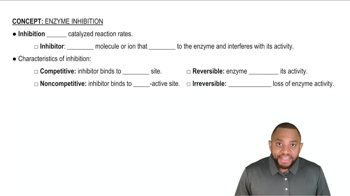
Enzyme Inhibition Concept 1

Noncompetitive Inhibition

Noncompetitive inhibition happens when an inhibitor binds to an enzyme at a site other than the active site, altering the enzyme's function regardless of substrate concentration. In this case, adding more substrate does not restore enzyme activity, as the inhibitor's presence affects the enzyme's ability to catalyze the reaction.
Recommended video:
Guided course
1:19
Enzyme Inhibition Concept 1

Enzyme Activity

Enzyme activity refers to the rate at which an enzyme catalyzes a reaction. It can be influenced by various factors, including substrate concentration, temperature, pH, and the presence of inhibitors. Understanding how inhibitors affect enzyme activity is crucial for determining the type of inhibition occurring in a biochemical reaction.
Recommended video:
Guided course
1:06
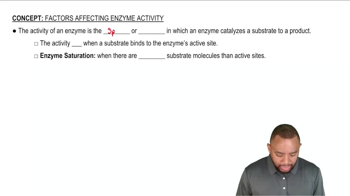
Factors Affecting Enzyme Activity Concept 1