Pearson+ LogoPearson+ Logo
Ch.10 Proteins Workers of the Cell
Frost - General, Organic and Biological Chemistry 4th Edition
Frost4th EditionGeneral, Organic and Biological ChemistryISBN: 9780134988696Not the one you use?Change textbook
Chapter 6, Problem 54c

Indicate whether each of the following describes a competitive or a noncompetitive inhibitor.
c. The inhibitor competes with the substrate for the active site.

Verified step by step guidance
1
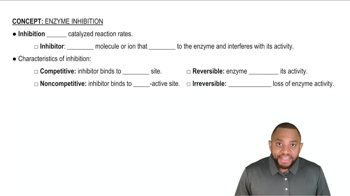
Understand the two types of enzyme inhibitors: Competitive inhibitors bind to the active site of the enzyme, directly competing with the substrate. Noncompetitive inhibitors bind to a different site on the enzyme, altering its shape and function without directly competing for the active site.
Analyze the statement provided: 'The inhibitor competes with the substrate for the active site.'
Recognize that this description matches the behavior of a competitive inhibitor, as it directly competes with the substrate for access to the enzyme's active site.
Recall that in competitive inhibition, increasing the concentration of the substrate can overcome the effect of the inhibitor, as the substrate and inhibitor vie for the same binding location.
Conclude that the correct classification for this description is a competitive inhibitor, based on the defining characteristic of competition for the active site.

Verified video answer for a similar problem:

This video solution was recommended by our tutors as helpful for the problem above.
Video duration:
2m
Was this helpful?

Key Concepts

Here are the essential concepts you must grasp in order to answer the question correctly.

Competitive Inhibition

Competitive inhibition occurs when an inhibitor molecule competes with the substrate for binding to the enzyme's active site. This type of inhibition can be overcome by increasing the concentration of the substrate, as more substrate molecules can outcompete the inhibitor for the active site. The presence of a competitive inhibitor increases the apparent Km (Michaelis constant) of the enzyme but does not affect the maximum reaction velocity (Vmax).
Recommended video:
Guided course
1:19
Enzyme Inhibition Concept 1

Active Site

The active site of an enzyme is a specific region where substrate molecules bind and undergo a chemical reaction. It is typically a pocket or groove on the enzyme's surface, formed by the unique three-dimensional structure of the enzyme. The shape and chemical environment of the active site are crucial for the enzyme's specificity and catalytic activity, allowing it to recognize and interact with particular substrates.
Recommended video:
Guided course
1:06
Factors Affecting Enzyme Activity Concept 1

Noncompetitive Inhibition

Noncompetitive inhibition occurs when an inhibitor binds to an enzyme at a site other than the active site, altering the enzyme's function regardless of whether the substrate is present. This type of inhibition decreases the overall number of active enzyme molecules available for catalysis, leading to a decrease in Vmax, while the Km remains unchanged. Noncompetitive inhibitors can bind to both the enzyme and the enzyme-substrate complex, making their effect independent of substrate concentration.
Recommended video:
Guided course
1:19
Enzyme Inhibition Concept 1