Ch. 9 - The Molecular Biology of Translation
Sanders - Genetic Analysis: An Integrated Approach 3rd Edition
Sanders3rd EditionGenetic Analysis: An Integrated ApproachISBN: 9780135564172Not the one you use?Change textbook
Chapter 9, Problem 1b

Some proteins are composed of two or more polypeptides. Suppose the DNA template strand sequence 3′-TACGTAGGCTAACGGAGTAAGCTAACT-5′ produces a polypeptide that joins in pairs to form a functional protein.
What term is used to identify a functional protein like this one formed when two identical polypeptides join together?

Verified step by step guidance
1
Step 1: Understand the problem. The question is asking for the term used to describe a functional protein formed when two identical polypeptides join together. This involves understanding protein structure and assembly.
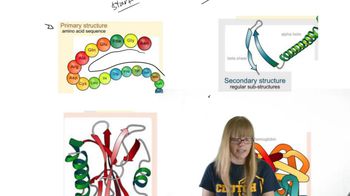
Step 2: Recall the concept of protein quaternary structure. Proteins can have up to four levels of structure: primary, secondary, tertiary, and quaternary. The quaternary structure refers to the arrangement of multiple polypeptide chains (subunits) in a protein.
Step 3: Identify the specific case described in the problem. The protein in question is formed by the joining of two identical polypeptides. This type of protein is referred to as a 'homodimer.'
Step 4: Define the term 'homodimer.' A homodimer is a protein complex formed when two identical polypeptide chains (subunits) bind together to create a functional protein.
Step 5: Relate the term to the problem. Since the functional protein described in the problem is formed by two identical polypeptides joining together, the correct term to describe it is 'homodimer.'

Verified video answer for a similar problem:

This video solution was recommended by our tutors as helpful for the problem above.
Video duration:
2m
Was this helpful?

Key Concepts

Here are the essential concepts you must grasp in order to answer the question correctly.

Polypeptide

A polypeptide is a chain of amino acids linked by peptide bonds, which are formed during the process of translation in protein synthesis. Polypeptides fold into specific three-dimensional structures to become functional proteins. The sequence of amino acids in a polypeptide is determined by the corresponding mRNA, which is transcribed from DNA.
Recommended video:

Dimer

A dimer is a type of protein complex formed when two identical or similar polypeptides (monomers) join together. This interaction can occur through various types of bonding, such as hydrogen bonds or disulfide bridges, and is crucial for the protein's functionality. Dimers can exhibit unique properties that differ from those of individual polypeptides.
Recommended video:
Guided course
01:45
DNA Proofreading

Protein Structure

Protein structure refers to the specific arrangement of amino acids in a polypeptide chain, which determines its function. Proteins have four levels of structure: primary (amino acid sequence), secondary (local folding patterns), tertiary (overall 3D shape), and quaternary (assembly of multiple polypeptides). Understanding these structures is essential for grasping how proteins interact and function in biological systems.
Recommended video:
Related Practice
Textbook Question

Answer the following questions for autosomal conditions such as PKU.

If the first child of parents who are both heterozygous carriers of a recessive mutant allele is homozygous recessive, what is the chance the second child of the couple will be homozygous recessive? What is the chance the second child will be a heterozygous carrier of the recessive mutation?

1
views
Textbook Question

Answer the following questions for autosomal conditions such as PKU.

If both parents are heterozygous carriers of a mutant allele, what is the chance that their first child will be homozygous recessive for the mutation?

3
views
Textbook Question

Some proteins are composed of two or more polypeptides. Suppose the DNA template strand sequence 3′-TACGTAGGCTAACGGAGTAAGCTAACT-5′ produces a polypeptide that joins in pairs to form a functional protein. What is the amino acid sequence of the polypeptide produced from this sequence?

Textbook Question

Homocystinuria is a rare autosomal recessive condition on the RUSP list of conditions screened by newborn genetic testing. The condition results from a mutation that blocks the degradation of the amino acid methionine. The absence of a critical enzyme causes the buildup of the compound homocysteine, which is one of the intermediate compounds in the methionine breakdown pathway. Homocystinuria causes mental impairment, heart problems, seizures, eye abnormalities, and a number of other symptoms that shorten life if not treated. The condition is treated by a specialized diet that is low in methionine and by the ingestion of several supplements.

The low-methionine diet must be maintained throughout life to manage homocystinuria. Why do you think this is the case?

Textbook Question

Homocystinuria is a rare autosomal recessive condition on the RUSP list of conditions screened by newborn genetic testing. The condition results from a mutation that blocks the degradation of the amino acid methionine. The absence of a critical enzyme causes the buildup of the compound homocysteine, which is one of the intermediate compounds in the methionine breakdown pathway. Homocystinuria causes mental impairment, heart problems, seizures, eye abnormalities, and a number of other symptoms that shorten life if not treated. The condition is treated by a specialized diet that is low in methionine and by the ingestion of several supplements.

Why do you think eating a low-methionine diet is critical to controlling homocystinuria?

Textbook Question

In the experiments that deciphered the genetic code, many different synthetic mRNA sequences were tested.

Describe how the codon for phenylalanine was identified.