Ch. 9 - The Molecular Biology of Translation
Sanders - Genetic Analysis: An Integrated Approach 3rd Edition
Sanders3rd EditionGenetic Analysis: An Integrated ApproachISBN: 9780135564172Not the one you use?Change textbook
Chapter 9, Problem B.2b

Homocystinuria is a rare autosomal recessive condition on the RUSP list of conditions screened by newborn genetic testing. The condition results from a mutation that blocks the degradation of the amino acid methionine. The absence of a critical enzyme causes the buildup of the compound homocysteine, which is one of the intermediate compounds in the methionine breakdown pathway. Homocystinuria causes mental impairment, heart problems, seizures, eye abnormalities, and a number of other symptoms that shorten life if not treated. The condition is treated by a specialized diet that is low in methionine and by the ingestion of several supplements.
The low-methionine diet must be maintained throughout life to manage homocystinuria. Why do you think this is the case?

Verified step by step guidance
1
Understand that homocystinuria is caused by a mutation leading to the absence of a critical enzyme needed to break down methionine, an essential amino acid.
Recognize that because the enzyme is missing or nonfunctional, methionine cannot be properly degraded, causing a buildup of homocysteine, a toxic intermediate.
Realize that if methionine intake is not controlled, excess methionine will continue to accumulate, leading to increased levels of homocysteine and worsening symptoms.
Understand that maintaining a low-methionine diet reduces the substrate (methionine) available for conversion into homocysteine, thereby minimizing toxic buildup.
Conclude that lifelong dietary management is necessary because the genetic defect is permanent, and without the enzyme, the body cannot process methionine normally at any stage of life.

Verified video answer for a similar problem:

This video solution was recommended by our tutors as helpful for the problem above.
Video duration:
2m
Was this helpful?

Key Concepts

Here are the essential concepts you must grasp in order to answer the question correctly.

Autosomal Recessive Inheritance

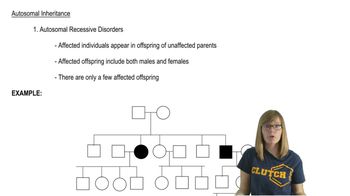
Autosomal recessive inheritance means that an individual must inherit two copies of a mutated gene, one from each parent, to express the disorder. Carriers with only one mutated gene typically do not show symptoms. Understanding this helps explain why homocystinuria appears in newborn screening and the genetic risk for families.
Recommended video:
Guided course
09:08
Autosomal Pedigrees

Methionine Metabolism and Enzyme Deficiency

Methionine is an essential amino acid broken down through a metabolic pathway involving several enzymes. In homocystinuria, a mutation causes deficiency of a critical enzyme, leading to accumulation of homocysteine, a toxic intermediate. This buildup causes the disease symptoms and underlies the need to control methionine intake.
Recommended video:
Guided course
07:58
Translation initiation

Dietary Management of Metabolic Disorders

Dietary management in metabolic disorders involves restricting substrates that accumulate due to enzyme deficiencies. For homocystinuria, a lifelong low-methionine diet reduces the production of homocysteine, preventing toxic buildup and associated symptoms. Supplements may also support alternative metabolic pathways or compensate for deficiencies.
Recommended video:
Guided course
02:48
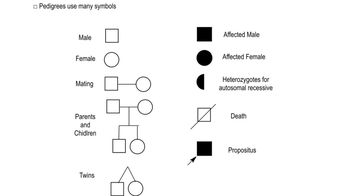
Pedigree Symbols
Related Practice
Textbook Question

Answer the following questions for autosomal conditions such as PKU.

If both parents are heterozygous carriers of a mutant allele, what is the chance that their first child will be homozygous recessive for the mutation?

3
views
Textbook Question

Some proteins are composed of two or more polypeptides. Suppose the DNA template strand sequence 3′-TACGTAGGCTAACGGAGTAAGCTAACT-5′ produces a polypeptide that joins in pairs to form a functional protein. What is the amino acid sequence of the polypeptide produced from this sequence?

Textbook Question

Some proteins are composed of two or more polypeptides. Suppose the DNA template strand sequence 3′-TACGTAGGCTAACGGAGTAAGCTAACT-5′ produces a polypeptide that joins in pairs to form a functional protein.

What term is used to identify a functional protein like this one formed when two identical polypeptides join together?

Textbook Question

Homocystinuria is a rare autosomal recessive condition on the RUSP list of conditions screened by newborn genetic testing. The condition results from a mutation that blocks the degradation of the amino acid methionine. The absence of a critical enzyme causes the buildup of the compound homocysteine, which is one of the intermediate compounds in the methionine breakdown pathway. Homocystinuria causes mental impairment, heart problems, seizures, eye abnormalities, and a number of other symptoms that shorten life if not treated. The condition is treated by a specialized diet that is low in methionine and by the ingestion of several supplements.

Why do you think eating a low-methionine diet is critical to controlling homocystinuria?

Textbook Question

In the experiments that deciphered the genetic code, many different synthetic mRNA sequences were tested.

Describe how the codon for phenylalanine was identified.

Textbook Question

In the experiments that deciphered the genetic code, many different synthetic mRNA sequences were tested.

What was the result of studies of synthetic mRNAs composed exclusively of cytosine?