Pearson+ LogoPearson+ Logo
Ch. 9 - The Molecular Biology of Translation
Sanders - Genetic Analysis: An Integrated Approach 3rd Edition
Sanders3rd EditionGenetic Analysis: An Integrated ApproachISBN: 9780135564172Not the one you use?Change textbook
Chapter 9, Problem 11c

Consider translation of the following mRNA sequence:
5′-...AUGCAGAUCCAUGCCUAUUGA...-3′
What events occur to permit the next tRNA to interact with mRNA?

Verified step by step guidance
1
Identify the start codon in the mRNA sequence. The start codon is AUG, which signals the beginning of translation and codes for methionine. This is where the ribosome assembles and translation begins.
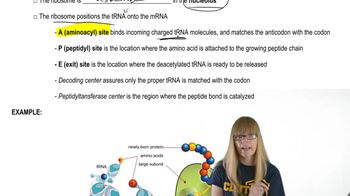
Recognize that the ribosome has three binding sites for tRNA: the A (aminoacyl), P (peptidyl), and E (exit) sites. The first tRNA carrying methionine binds to the P site, as it corresponds to the start codon.
The ribosome moves along the mRNA sequence in the 5′ to 3′ direction. The next codon (CAG in this case) is exposed in the A site, allowing the corresponding tRNA with the complementary anticodon to bind.
The ribosome facilitates the formation of a peptide bond between the amino acid on the tRNA in the P site (methionine) and the amino acid on the tRNA in the A site. This elongates the polypeptide chain.
The ribosome translocates, shifting the tRNA in the A site to the P site, and the tRNA in the P site to the E site, where it exits the ribosome. This process allows the next codon to be exposed in the A site, permitting the next tRNA to interact with the mRNA.

Verified video answer for a similar problem:

This video solution was recommended by our tutors as helpful for the problem above.
Video duration:
4m
Was this helpful?

Key Concepts

Here are the essential concepts you must grasp in order to answer the question correctly.

Translation Process

Translation is the process by which ribosomes synthesize proteins using mRNA as a template. It involves three main stages: initiation, elongation, and termination. During elongation, tRNA molecules bring amino acids to the ribosome, matching their anticodons with the codons on the mRNA, facilitating the assembly of the polypeptide chain.
Recommended video:
Guided course
08:39
mRNA Processing

tRNA Structure and Function

Transfer RNA (tRNA) is a type of RNA that carries amino acids to the ribosome during protein synthesis. Each tRNA has a specific anticodon that pairs with a corresponding codon on the mRNA, ensuring the correct amino acid is added to the growing polypeptide chain. The structure of tRNA allows it to recognize and bind to both the mRNA codon and its specific amino acid.
Recommended video:
Guided course
08:26
Functional Genomics

Ribosome Function

Ribosomes are the cellular machinery responsible for protein synthesis. They consist of ribosomal RNA (rRNA) and proteins, forming two subunits that come together during translation. The ribosome facilitates the binding of tRNA to mRNA, catalyzing the formation of peptide bonds between amino acids, thus enabling the elongation of the polypeptide chain.
Recommended video:
Guided course
03:49
Ribosome Structure
Related Practice
Textbook Question

Suppose a man and a woman are each heterozygous carriers of a mutation causing a fatal hereditary disease not on the RUSP list. Prenatal genetic testing can identify the genotype of a fetus with regard to this disease and can identify fetuses with the disease. What do you think are the three or four most important factors this couple should consider in their decision making about having children?

Textbook Question

Consider translation of the following mRNA sequence:

5′-...AUGCAGAUCCAUGCCUAUUGA...-3′

Diagram translation at the moment the fourth amino acid is added to the polypeptide chain. Show the ribosome; label its A, P, and E sites; show its direction of movement; and indicate the position and anticodon triplet sequence of tRNAs that are currently interacting with mRNA codons.

Textbook Question

Consider translation of the following mRNA sequence:

5′-...AUGCAGAUCCAUGCCUAUUGA...-3′

What is the anticodon triplet sequence of the next tRNA to interact with mRNA?

1
views
Textbook Question

If you were to look up Gaucher disease on the OMIM website, you would see that there are three major types, designated Type I (OMIM 230800), Type II (OMIM 230900), and Type III (OMIM 231000). All three types are mutations of the gene for acid-β-glucosidase, encoded on chromosome 1. Different mutations of this gene produce the three types of Gaucher disease that differ somewhat in their symptoms and disease severity.

Thinking about the production or function of the acid-β-glucosidase enzyme, why do you suppose different mutations of this gene produce differences in symptoms and disease severity?

Textbook Question

If you were to look up Gaucher disease on the OMIM website, you would see that there are three major types, designated Type I (OMIM 230800), Type II (OMIM 230900), and Type III (OMIM 231000). All three types are mutations of the gene for acid-β-glucosidase, encoded on chromosome 1. Different mutations of this gene produce the three types of Gaucher disease that differ somewhat in their symptoms and disease severity.

For each mutation, speculate about whether the acid-β-glucosidase enzyme is merely reduced in function or whether its production is eliminated, and explain why.

Textbook Question

The diagram of a eukaryotic ribosome shown below contains several errors.

Examine the diagram carefully, and identify each error.