Pearson+ LogoPearson+ Logo
Ch. 9 - The Molecular Biology of Translation
Sanders - Genetic Analysis: An Integrated Approach 3rd Edition
Sanders3rd EditionGenetic Analysis: An Integrated ApproachISBN: 9780135564172Not the one you use?Change textbook
Chapter 9, Problem 5c

A portion of a DNA template strand has the base sequence
5′-...ACGCGATGCGTGATGTATAGAGCT...-3′
Which is the third amino acid added to the polypeptide chain?

Verified step by step guidance
1
Identify the direction of the DNA template strand. The given sequence is 5′ to 3′, but transcription occurs in the 3′ to 5′ direction. Therefore, the complementary mRNA strand will be synthesized in the 5′ to 3′ direction.
Write the complementary mRNA sequence by pairing the bases of the DNA template strand. Use the base-pairing rules: Adenine (A) pairs with Uracil (U), Cytosine (C) pairs with Guanine (G), Guanine (G) pairs with Cytosine (C), and Thymine (T) pairs with Adenine (A).
Divide the mRNA sequence into codons (groups of three nucleotides) starting from the 5′ end. Each codon corresponds to one amino acid.
Use the genetic code table to determine the amino acid for each codon. Locate the third codon in the sequence and identify the corresponding amino acid.
Understand that the polypeptide chain is synthesized starting from the N-terminus to the C-terminus. The third amino acid added to the chain corresponds to the amino acid encoded by the third codon in the mRNA sequence.

Verified video answer for a similar problem:

This video solution was recommended by our tutors as helpful for the problem above.
Video duration:
2m
Was this helpful?

Key Concepts

Here are the essential concepts you must grasp in order to answer the question correctly.

DNA Transcription

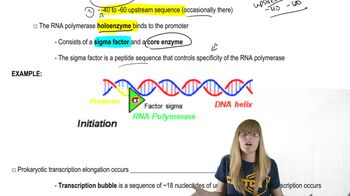
DNA transcription is the process by which a segment of DNA is copied into RNA by the enzyme RNA polymerase. During transcription, the DNA template strand is read in the 3' to 5' direction, and a complementary RNA strand is synthesized in the 5' to 3' direction. This process is crucial for converting genetic information stored in DNA into messenger RNA (mRNA), which carries the code for protein synthesis.
Recommended video:
Guided course
10:14
Prokaryotic Transcription

Codons and Amino Acids

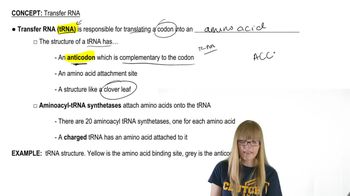
Codons are sequences of three nucleotides in mRNA that correspond to specific amino acids or stop signals during protein synthesis. Each codon is translated into an amino acid by the ribosome, which reads the mRNA sequence. Understanding the genetic code, which maps codons to their respective amino acids, is essential for determining the sequence of a polypeptide chain.
Recommended video:

Translation

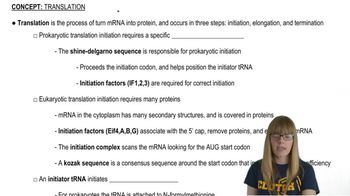
Translation is the process by which the sequence of codons in mRNA is decoded to synthesize a polypeptide chain. This occurs in the ribosome, where transfer RNA (tRNA) molecules bring the appropriate amino acids to the growing polypeptide based on the codon sequence. The order of amino acids in the polypeptide determines its structure and function, making translation a critical step in gene expression.
Recommended video:
Guided course
07:58
Translation initiation
Related Practice
Textbook Question

Describe the gene and protein defects in phenylketonuria (PKU). How are these defects connected to disease symptoms?

Textbook Question

A portion of a DNA template strand has the base sequence

5′-...ACGCGATGCGTGATGTATAGAGCT...-3′

Identify the sequence and polarity of the mRNA transcribed from this fragmentary template-strand sequence.

Textbook Question

A portion of a DNA template strand has the base sequence

5′-...ACGCGATGCGTGATGTATAGAGCT...-3′

Assume the mRNA is written in the correct reading frame. Determine the amino acid sequence encoded by this fragment. Identify the N- and C-terminal directions of the polypeptide.

Textbook Question

Describe three features of tRNA molecules that lead to their correct charging by tRNA synthetase enzymes.

Textbook Question

A couple and some of their relatives are screened for Gaucher disease in a community-based screening program. The woman is homozygous for the dominant allele, represented by G. The woman's father, sister, and paternal grandmother are heterozygous carriers of the mutant allele, represented by g. Her paternal grandfather, her mother, and both of her mother's parents are homozygous for the dominant allele. The man is heterozygous and he has a brother with Gaucher disease. The man's parents and grandparents have not been tested, but it is known that none of them has Gaucher disease.

On the pedigree, write the genotypes (GG, Gg, or gg) for each person who has been tested or for whom you can deduce a genotype. If a genotype cannot be determined completely, list the alleles you know or deduce must be present.

3
views
Textbook Question

A couple and some of their relatives are screened for Gaucher disease in a community-based screening program. The woman is homozygous for the dominant allele, represented by G. The woman's father, sister, and paternal grandmother are heterozygous carriers of the mutant allele, represented by g. Her paternal grandfather, her mother, and both of her mother's parents are homozygous for the dominant allele. The man is heterozygous and he has a brother with Gaucher disease. The man's parents and grandparents have not been tested, but it is known that none of them has Gaucher disease.

Explain why you are able to assign genotypes to the man's parents despite their not being tested.

4
views